
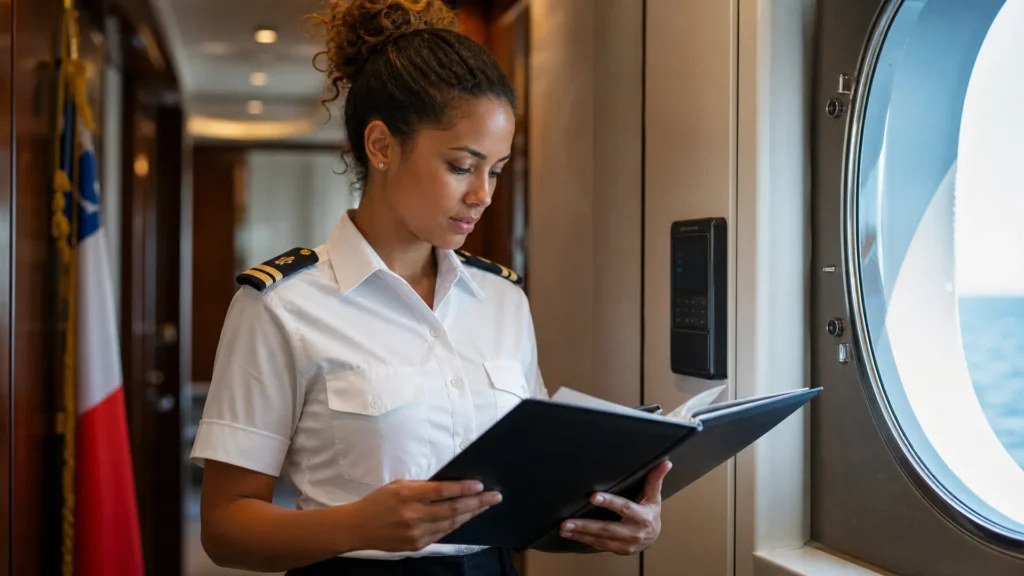
ISPS Code Superyacht Training for Crew Security Compliance
ISPS Code superyacht training is one of those compliance requirements that catches new crew off guard, and even some experienced hands underestimate what it actually demands. Whether you’re joining your first vessel or stepping up to a senior officer role, understanding the ISPS Code is not optional. It’s a legal obligation tied directly to STCW, and port state authorities can and do check compliance.
What Is the ISPS Code and Why Does It Apply to Superyachts?
The International Ship and Port Facility Security Code was developed by the International Maritime Organization (IMO) in direct response to the September 2001 terrorist attacks. Governments recognised that ships and ports were significant security vulnerabilities, and a coordinated international framework was needed fast.
How the ISPS Code came into force
The IMO adopted the ISPS Code at a Diplomatic Conference in December 2002, incorporated within SOLAS Chapter XI-2. It became mandatory on 1 July 2004, one of the fastest-ratified maritime security instruments in history. From that date, any vessel, port, or flag state operating within the code’s scope was legally required to comply.
Which superyachts fall under ISPS requirements
The size threshold is 500 gross tonnage. Any commercial vessel of 500 GT or above on an international voyage must comply with the ISPS Code. That includes a significant number of charter superyachts, particularly those doing Mediterranean-to-Caribbean seasonal rotations.
A superyacht operating commercially on international voyages above 500 GT must hold a valid International Ship Security Certificate (ISSC) and maintain an approved Ship Security Plan at all times. The ISSC is issued by the flag state and confirms the vessel has met all ISPS requirements. Without it, access to many international ports can be refused.
Private (non-commercial) yachts below 500 GT technically fall outside mandatory ISPS scope. Many owners and managers choose to comply voluntarily, and crew training remains best practice regardless.
ISPS Security Levels Explained: What Crew Must Know
The ISPS Code operates across three defined security levels. These levels are set by governments and port authorities, and they determine the security posture your vessel must maintain. Every crew member with any security responsibility needs to understand what each level means operationally.
Security Level 1, 2 and 3, crew responsibilities at each level
Security Level 1 is the baseline, normal operating conditions. At this level, crew carry out routine security measures: monitoring access points, checking IDs of visitors, maintaining an anchor or berth watch, and keeping the vessel’s security log up to date. Most of the time, your yacht operates at Level 1.
Security Level 2 means a heightened threat has been identified. The Ship Security Officer (SSO) is notified, access controls tighten, and additional watch-keeping measures come into force. Crew may be required to search bags and restrict guest movement in certain areas. Response times for security incidents shorten.
Security Level 3 is an imminent threat or an actual security incident. At this level, the vessel operates under direct instruction from port or government authorities. Non-essential movement stops, restricted areas are enforced strictly, and the SSO is in continuous contact with external agencies. Level 3 is rare, but every crew member must know what to do when it’s declared.
As the threat level rises, crew responsibilities escalate. Situational awareness and clear communication are not soft skills at Level 2 or 3, they are operational requirements.
ISPS Code Training Requirements for Superyacht Crew
This is where many crew, and some employers, get it wrong. Not everyone on board has the same training obligation. The STCW 2010 Manila Amendments introduced specific requirements under Regulation VI/6 that create two distinct tiers.
Designated Security Duties vs. general crew awareness
Under STCW Regulation VI/6, all seafarers must complete security awareness training. This covers recognising security threats, understanding procedures, and knowing how to report a concern. It’s the minimum threshold, and it applies to every person serving on a vessel subject to SOLAS Chapter XI-2.
Crew with designated security duties must go further. If your role involves access control, security patrols, monitoring surveillance equipment, or operating security systems, you hold a designated security function. Under Tables A-VI/6-1 and A-VI/6-2 of the Manila Amendments, you are required to complete a more detailed approved training programme. A deckhand assigned to access-control watch at a marina berth, for example, holds a designated security duty and must complete that full training, not just the awareness module.
This distinction matters during port state control inspections. An officer presenting only an awareness certificate while performing designated security duties is non-compliant, and that can hold up a vessel in port.
The Ship Security Officer (SSO) role on a superyacht
Every ISPS-compliant vessel must designate a Ship Security Officer. On a superyacht, this is typically the Captain or a senior deck officer. The SSO is responsible for implementing and maintaining the Ship Security Plan, conducting security drills, liaising with the Company Security Officer (CSO) and Port Facility Security Officers (PFSOs), and managing the vessel’s response across all three threat levels.
SSO training is a separate, dedicated qualification aligned with IMO Model Course 3.19. It covers threat assessment, security equipment, incident response, and the legal framework the SSO operates within. The SSO is the operational bridge between the Ship Security Plan on paper and the crew’s ability to execute it under pressure. Captains taking command of a commercially operated vessel over 500 GT need this certificate before the vessel sails.
Superyacht Security Compliance: The Ship Security Plan
The Ship Security Plan is the central operational document for any ISPS-compliant vessel. Every crew member subject to the ISPS Code should know it exists, where it is kept, and what their specific responsibilities within it are.
The SSP is written specifically for each vessel, it is not a generic template. It contains a threat and vulnerability assessment of the ship, defined security procedures for each of the three levels, responsibilities assigned to named roles, emergency contact information, and a schedule of required drills. Flag states approve the SSP before issuing the ISSC, and it must be reviewed and updated whenever the vessel’s operations change significantly.
Crew are expected to know the sections relevant to their duties. A bosun responsible for gangway access needs to know the access-control procedures inside out. An engineer who rarely leaves the engine room still needs to know how to raise a security alarm and who the SSO is.
The SSP is also a confidential document. It should not be shown to guests or visitors, and its contents should not be discussed openly in port. Security through operational discipline, not just paperwork, is the code’s intent.
In practice, compliance means treating the SSP as a living document, not a folder gathering dust in the captain’s cabin. Regular drills, documented in the ship’s security log, demonstrate active compliance to any inspecting authority.
How ISPS Compliance Fits Into a Broader Superyacht Crew Career
ISPS training does not sit in isolation. It is part of the wider certification framework every professional crew member builds over their career. STCW certification requirements for superyachts form the foundation, and the Manila Amendments that govern ISPS training sit squarely within that framework. ISPS compliance is a STCW requirement, not a separate optional extra.
Deck officers and ratings feel the direct impact most. Superyacht deck crew roles and career progression are closely tied to security responsibilities, particularly around access control and anchor watch. Interior crew assigned to any security duty must also hold the correct training, and flag state audits in 2026 are scrutinising this more closely.
For crew building their profile from scratch, how to get started as superyacht crew with no maritime experience is a useful starting point. Security awareness training is one of the early certifications worth stacking alongside your STCW Basic Safety Training. Other mandatory STCW safety certifications for yacht crew, first aid, fire prevention, personal survival, sit in the same compliance tier and are expected together.
Captains and owners hiring crew in 2026 expect candidates to arrive with their compliance documentation in order. Arriving with your ISPS training already complete, awareness-level or designated-duties, depending on your intended role, signals that you understand your obligations before you set foot on board. In this industry, that matters.
At Superyacht Training Academy, we prepare crew to meet both the awareness-level and designated-duties requirements of STCW VI/6, ensuring candidates can demonstrate compliance to any flag state authority or port security officer from day one.
Explore the full range of superyacht crew training courses to find the ISPS and security training that matches your current rank and career stage.