
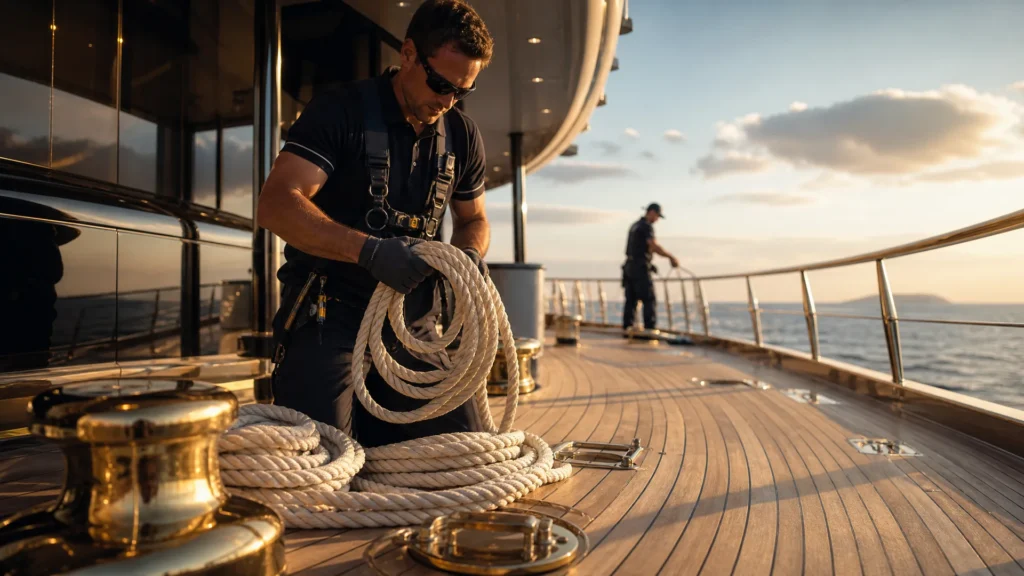
Superyacht deck crew jobs sit at the center of how a vessel operates, looks, and feels to everyone aboard. Whether a yacht is crossing the Atlantic or hosting guests in the Mediterranean, the deck team keeps the operation safe, sharp, and running to the standard the industry demands. If you’re considering this career path, understanding what each role involves, and how to progress through the ranks, gives you a genuine head start.
What Deck Crew Jobs on a Superyacht Actually Involve
Deck crew are the operational backbone of any superyacht. They maintain the vessel’s exterior, handle lines during docking and departures, launch and operate tenders, and ensure safety at sea. They’re also visible to owners and guests every day, which means presentation and service awareness matter as much as seamanship.
This sets superyacht work apart from commercial maritime roles or crewing on smaller charter yachts. The technical bar is high, but so is the expectation around conduct, discretion, and attention to detail. A deckhand on a 60-metre superyacht operates closer to five-star hospitality standards than to those of a fishing vessel crew. That combination is what makes the role both demanding and worth pursuing.
The Deck Crew Positions: From Deckhand to Deck Officer
On a typical large superyacht (50m+), the deck team operates under a clear rank structure: one or two deckhands report to a bosun, who answers to the chief officer, who is accountable to the captain. This chain of command mirrors commercial maritime standards, with an added layer of guest-service responsibility specific to private yachting.
Junior Deckhand / Deckhand
The deckhand superyacht role is the entry point for most people joining the industry. Day-to-day duties include washing and polishing the exterior, handling mooring lines, assisting with tender operations, and maintaining deck equipment. Junior deckhands report directly to the bosun and are closely supervised in their first season. The role typically requires STCW Basic Safety Training, an ENG1 medical certificate, and a genuine willingness to learn. Prior maritime experience is not always essential, but a practical mindset and physical fitness are non-negotiable.
Bosun
The bosun superyacht role is a genuine leadership position. The bosun manages all deck maintenance schedules, oversees tender launches, and briefs deckhands before guest activities. It is a real stepping stone to a deck officer ticket, not a lateral move. Bosuns report to the chief officer and are expected to plan work, manage small teams, and communicate clearly with senior officers. Candidates typically have two or more seasons of deckhand experience, a Powerboat Level 2 or PWC licence, and often an RYA Yacht Master Offshore certificate in progress.
Deck Officer (Officer of the Watch / Chief Officer)
The deck officer yacht role requires a certified watchkeeping qualification, typically an MCA Officer of the Watch (OOW) 500GT or 3000GT certificate, depending on vessel size. Chief officers oversee the entire deck department, manage safety drills, take navigation watches, and serve as the captain’s primary operational deputy. They carry direct responsibility for the safety of the vessel and everyone aboard during their watch. This role demands deep technical competence and the leadership maturity to manage a full deck team under pressure.
Captain
The captain holds ultimate command and legal responsibility for the superyacht, its crew, and its guests. Beyond navigation and seamanship, captains manage budgets, liaise with owners and management companies, and make final calls on all safety decisions. Most superyacht captains hold an MCA Master 3000GT (Yacht) certificate or equivalent, backed by many years of progressive sea service. Reaching this level is a long-term goal, but the deck crew positions below it form a clear and structured route toward it.
Superyacht Deck Career Progression: How You Move Up
Career progression in superyacht deck crew jobs is driven by two things: sea-service days and certifications. Understanding both early saves you time and positions you for faster advancement.
Building Sea Time and STCW Foundations
Every paid crew role on a commercial vessel over 24 metres requires STCW Basic Safety Training, covering fire prevention, sea survival, first aid, and personal safety, as mandated by the Maritime and Coastguard Agency and its international equivalents. This is the non-negotiable first step. Alongside your STCW, accumulating logged sea-service days is how the certification pathway unlocks: the MCA uses verified sea time as a core requirement for every rank above deckhand.
For those starting from scratch, our complete guide to STCW certification for superyacht crew walks through exactly what’s required and how to get started. If you have no maritime background at all, how to break into the industry with no maritime background covers the practical first steps before you ever set foot on a yacht.
Gaining Rank: From Bosun to Officer
Moving from deckhand to bosun is largely experience-driven, captains promote crew who demonstrate reliability, initiative, and practical skill. Moving from bosun to deck officer requires a formal certification step: an RYA/MCA Yacht Master Offshore certificate is the typical bridge qualification, followed by an OOW 500GT for larger commercial vessels.
Deck crew who build their certification portfolio early, rather than waiting until they’re already onboard, tend to access higher-tier vessels faster and negotiate better starting positions. Captains and chief officers can see immediately that a candidate is serious about a professional career rather than a working holiday, and that matters during hiring.
The progression is merit-based and transparent. There is no fixed timeline, but committed crew who are deliberate about sea time and qualifications can move from deckhand to bosun within a couple of seasons, and from bosun to officer over the following years.
Key Skills and Attributes Superyacht Captains Look For
Hard skills matter. Captains want deck crew who can handle lines correctly, operate a tender or RIB confidently, assist with anchoring and mooring in tight spaces, and apply basic navigation and safety procedures. PWC and Powerboat Level 2 qualifications signal practical on-water competence before you even interview.
Soft skills carry equal weight on a superyacht. Guest-facing composure, staying calm and professional when owners and their guests are on deck, is something captains assess from day one. So is teamwork under pressure: a small deck team needs to function without friction during demanding passages or busy charter turnarounds. Attention to detail in vessel presentation is another consistent priority; a yacht that doesn’t look immaculate reflects on the entire crew.
Self-starters who ask questions, show up early, and take ownership of their tasks stand out quickly in a small team environment.
Certifications That Open Doors to Deck Crew Jobs on Superyachts
Three certifications are non-negotiable for any paid superyacht role:
- STCW Basic Safety Training, the international legal baseline for commercial crew
- ENG1 Medical Certificate, confirms fitness for sea service
- PDSD (Proficiency in Designated Security Duties), required for commercial vessels under the ISPS Code
Beyond these, competitive CVs typically include RYA Powerboat Level 2, a PWC (Jetski) licence, and RYA Day Skipper, the last of which starts building the navigational knowledge you’ll need for officer-level progression.
Candidates who pair STCW Basic Safety Training with a Powerboat Level 2 consistently report stronger responses from crew agents. Together, those two credentials signal both legal compliance and practical on-water competence.
SYTA offers all of these qualifications in structured packages designed for candidates entering the industry. The superyacht crew training courses at SYTA are the most efficient way to identify which combination fits your current experience level and target role.
Is a Superyacht Deck Career Right for You?
The lifestyle is distinctive. Rotational schedules mean extended periods away from home, typically several months on, with leave between contracts. Physical demands are real: early starts, outdoor work in all conditions, and manual labour are part of the job at every rank. These are honest realities, not reasons to be discouraged.
The upsides are equally real. Superyacht deck crew earn competitive, largely tax-free salaries that compare favourably to shore-based roles at equivalent experience levels. Career progression is faster than in most industries, a motivated deckhand can reach bosun or officer level in a timeframe that would take far longer in commercial shipping. Travel is built into the work: the Mediterranean, the Caribbean, the Pacific, and beyond are regular ports of call, not holiday destinations.
If you’re physically fit, motivated, and ready to commit to professional standards from day one, superyacht deck crew jobs offer a career path that rewards that investment quickly and tangibly.
Ready to take the first step? Find a Course at SYTA and build the certification foundation that gets your CV in front of the right captains.