
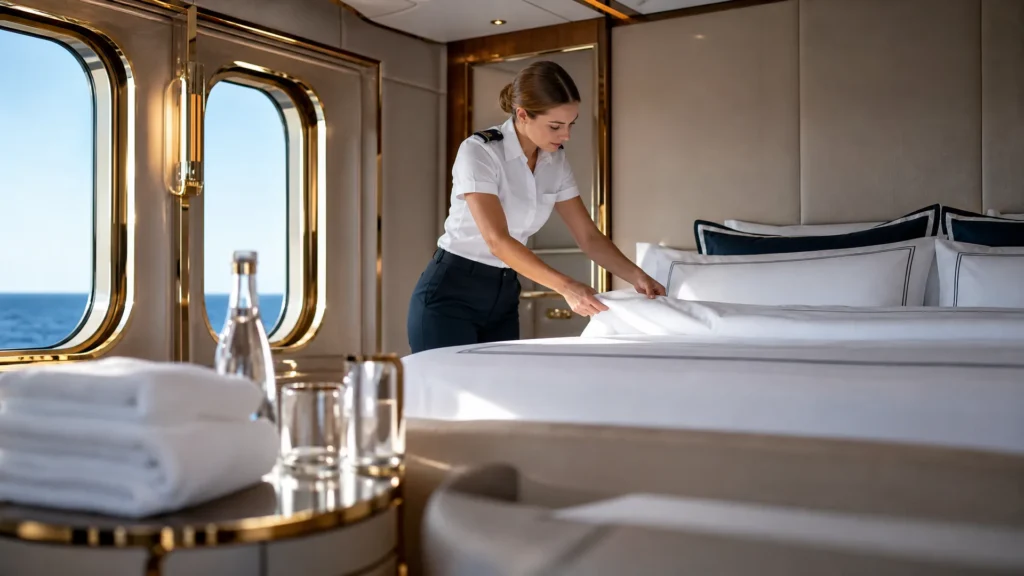
Superyachts run on hospitality, and every guest interaction starts with the stew. If you’re looking for a direct route into that role, a superyacht stew training course is the fastest way to get certified, get hired, and get on board. This guide covers the certifications, day-to-day skills, and hiring steps that get an entry-level stew from shore to superyacht.
What Is a Superyacht Stew and Why Training Matters
A superyacht stew is the entry-level member of the interior team. She (or he) handles guest service, cabin care, laundry, and general housekeeping under the direction of the chief stewardess or purser.
A chief stew manages the whole interior department, budgets, and provisioning. A junior stew focuses on execution: setting tables, cleaning cabins, serving meals, and supporting whatever the day’s charter guests need. The full breakdown of interior crew roles shows where the stew sits relative to 2nd stews, chief stews, and pursers.
Captains rarely hire anyone for interior work, junior or senior, without baseline maritime certification. Even a first-time stew with no yachting background needs proof of safety training and medical fitness before an agency will submit a CV. That’s the gap purpose-built training closes.
Stew Duties and Training: What the Role Actually Involves
Day to day, a junior stew’s job blends hotel-style service with maritime discipline. Expect cabin turnovers, linen changes, provisioning runs, table setting, and drink service during charter.
Yachts operate to a higher standard than most hotels. Guests expect five-star service in a moving, confined space, often on a tight schedule. A structured course teaches the pace and precision that on-the-job learning alone can’t cover fast enough.
Core Certifications Every Superyacht Stew Needs
Before any hospitality skill counts, every stew needs three baseline qualifications. These aren’t optional extras. They’re the legal minimum for working on a commercial or private superyacht.
STCW for Interior Crew: The Non-Negotiable Basic Safety Course
STCW stands for Standards of Training, Certification and Watchkeeping. It’s an international requirement, not just a deckhand qualification. Interior crew need it too.
The course covers firefighting, sea survival, first aid, and personal safety and social responsibility. It typically runs several days and results in a certificate valid for five years. No captain will hire interior crew without it, regardless of experience level. For the specifics, see the STCW Basic Safety Training course requirements or the complete guide to STCW certification.
ENG1 Medical Certificate: Getting Certified Fit for Sea
An ENG1 is a medical certificate confirming a candidate is fit to work at sea. An approved doctor issues it after an exam that checks vision, hearing, general fitness, and any conditions that could affect safety onboard.
Most flag states and employers require a valid ENG1 before crew step on a boat. It’s usually valid for two years, and renewing it is straightforward if health hasn’t changed. Along with STCW and a food safety or hygiene certificate, the ENG1 forms the third pillar every stew needs before hospitality training even starts.
What a Superyacht Stew Training Course Covers Day to Day
Once the legal certifications are sorted, a dedicated stew course builds the hospitality skills that separate a job offer from a rejection email. This is where generic hotel training falls short and yacht-specific training pays off.
A typical junior stew course pairs STCW Basic Safety Training with silver service, wine service, and cabin and laundry housekeeping modules over one to two weeks. That structure mirrors how interior teams are actually organized onboard. Graduates start work already speaking the same language as their new team.
Hospitality and Silver Service Skills for Superyachts
Silver service, table setting, napkin folding, and formal dining etiquette all get practical, hands-on attention. Courses also cover guest interaction standards: how to anticipate needs, manage privacy expectations, and handle high-net-worth guests with discretion.
This goes beyond what most hospitality schools teach. Yacht service happens in tight spaces, often at sea, with no room for a second attempt mid-service. For readers wanting the broader context, the foundations of high-end hospitality training lays out how these standards translate from five-star hotels to yacht interiors.
Wine Service and Interior Housekeeping Standards
Wine service training covers proper pouring technique, pairing basics, and how to present and store wine correctly in a yacht’s limited storage. Beverage service more broadly includes cocktails, coffee, and formal drink service during charter.
Housekeeping modules cover laundry care for delicate and formal guest clothing, cabin turnover standards, and the cleaning routines yachts expect between charters. Together, these modules turn a certificate holder into someone ready to work a real charter schedule from day one.
Why Train in Cape Town With SYTA
Cape Town has become a recognised entry point for aspiring interior crew. Compared with traditional hubs like Antibes or Fort Lauderdale, it offers a lower cost of living, a growing charter and refit season, and a strong concentration of accredited training providers.
That combination matters for someone funding their own certifications before their first paycheck. Training costs and living expenses in Cape Town stretch further, and the seasonal hiring calendar gives newly certified stews a realistic shot at their first contract soon after graduating.
SYTA’s Cape Town campus runs entry-level interior crew training built specifically around STCW, ENG1, and food hygiene requirements. Graduates leave course-ready for dockwalking rather than needing to chase down separate certifications from multiple providers. That single-campus model saves time and cuts the confusion that trips up a lot of first-time applicants.
From Certificate to First Stew Job: Landing a Role With No Experience
Yes, it’s realistic to become a superyacht stew with no prior experience. The industry hires on certification, attitude, and presentation far more than on a maritime résumé. Career-changers move into this path every season.
The route to a first job usually runs through two channels: crew agencies and dockwalking. Agencies match certified candidates to yacht vacancies. They’re often the fastest route once a CV and certificates are in order. Dockwalking, physically visiting marinas and approaching yachts directly, still works well in hiring hotspots and complements agency applications.
How to Get Hired as a Superyacht Stew Without Prior Experience
A strong entry-level CV leads with certifications, not job history. List STCW, ENG1, food hygiene, and any hospitality or wine service training right at the top, followed by any relevant customer service work, even outside yachting.
Photos matter more in this industry than most. A clean, professional headshot and a full-length photo in smart-casual clothing are standard on a yacht crew CV. Keep the document to one page and register with several agencies rather than just one.
For a deeper look at breaking in with zero maritime background, see starting a yacht crew career with no experience. It’s a realistic path. Thousands of current crew started exactly where you are now: certified, uncertain, and ready to work.
Superyacht Stew Salary and Career Progression
Junior stewardess starting salaries typically begin in the low-to-mid thousands of dollars per month, plus tips and, on many boats, service charge shares. Exact pay depends on yacht size, itinerary, and experience, but that range holds broadly across the industry.
From there, progression is fairly linear. A junior stew who builds experience and adds certifications typically moves into a 2nd stew role, then toward chief stewardess as she takes on more responsibility for budgeting, provisioning, and team management. Each step up usually comes with a meaningful pay increase and more autonomy over the interior department.
Further certifications, silver service, wine and spirits qualifications, and eventually management-level training, all support that climb. It’s worth mapping the qualifications for the path to becoming a chief stewardess early, even while still working toward that first junior contract. And for the full rank-by-rank numbers, the steward salary and benefits by rank breakdown covers what to expect at each stage.
Getting started is the hard part, and it’s also the part a good course solves directly. With STCW, ENG1, food hygiene, and hands-on service training in hand, a new stew can approach agencies and marinas with confidence. If you’re ready to move from research to enrollment, enroll in the Deck-Stew Career Course or use Find a Course to compare start dates at SYTA’s Cape Town campus.