
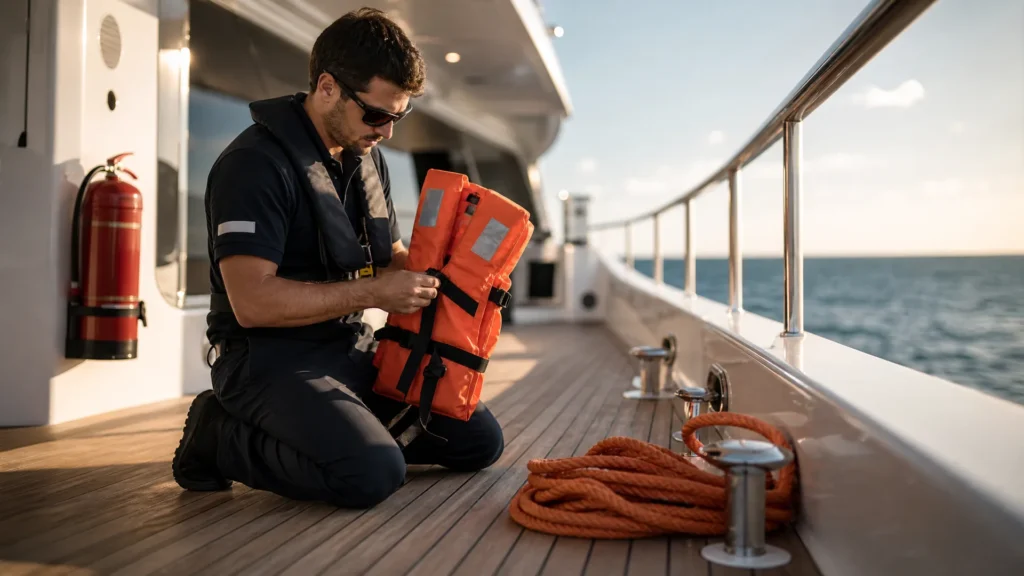
If you want to work on a superyacht, an STCW basic safety training course is the first thing on your checklist. No captain, chief stew, or engineer will consider you for a trial day without it. This certificate is the entry ticket to the industry. Knowing what it covers, how long it takes, and what it costs in Cape Town will help you plan your route to your first job on deck.
What Is STCW Basic Safety Training and Why Yachts Require It
STCW stands for Standards of Training, Certification and Watchkeeping. It’s an international convention that sets minimum safety training for anyone working at sea, and it applies to superyachts just as much as cargo ships. STCW Basic Safety Training, usually shortened to STCW BST, is the foundation course under that convention. It covers survival, firefighting, first aid, and personal safety.
Yachts require it because it’s not optional. It’s a legal baseline. A vessel operating commercially can’t legally crew someone who hasn’t completed it. Insurers, flag states, and port authorities all expect to see it on file. That’s why captains and recruiters treat it as a non-negotiable document rather than a nice-to-have.
STCW requirements for superyacht crew explained
The STCW requirements for superyacht crew are the same no matter what role you’re aiming for. Deckhand, stewardess, chef, or junior engineer: everyone needs the basic safety certificate before they can step aboard in a working capacity. It exists to make sure every person on board can respond competently in an emergency, whether that’s a fire, a person overboard, or a medical incident.
Because the requirement is universal, it’s also the most efficient first step for anyone new to the industry. Complete it once, and you meet the legal minimum for any department you decide to pursue. For a broader look at how this fits into the wider certification picture, the complete STCW certification guide for superyachts breaks down every tier beyond the basic course.
What’s Included in an STCW Basic Safety Training Course
An STCW course for yacht crew is built around four core modules. Each one addresses a distinct type of emergency you could face at sea. Together they form a single, standardized skill set, so any qualified crew member on any yacht in any country has the same baseline training.
Training moves between classroom sessions and hands-on practical work, usually in a pool and on live-fire equipment. You leave with muscle memory, not just theory.
STCW personal survival techniques
This module covers what to do if you end up in the water or need to abandon ship. You’ll practice donning a lifejacket correctly, boarding and righting a life raft, and using survival equipment in a pool setting. It also covers hypothermia awareness and how to signal for rescue. This is usually the most physical part of the course.
STCW firefighting training
Fire is one of the most serious risks on any vessel, so STCW firefighting training gets significant time. You’ll learn fire theory, how different extinguishing agents work, and how to use breathing apparatus. Most courses include a live-fire practical exercise, where you actually fight a controlled fire under instructor supervision. This module builds confidence fast. There’s no substitute for handling real flames and real equipment.
STCW first aid module and social responsibilities and security
The STCW first aid module covers elementary first aid: how to assess a casualty, manage bleeding, treat burns, and perform CPR. It’s built for a first responder on board, not a medical professional, so it stays practical and scenario-based. For crew who want to go deeper into medical response, STCW first aid legal requirements for crew covers what additional training is expected once you’re working.
The final module, personal safety and social responsibilities, deals with your legal obligations as a crew member. This includes shipboard communication, teamwork, environmental awareness, and basic security procedures. It overlaps closely with wider security compliance topics. If you want more detail on that side, ISPS security compliance training for crew picks up where this module leaves off.
How Long Does STCW Basic Safety Training Take, and What Does It Cost in Cape Town
STCW Basic Safety Training typically runs over roughly five days, combining classroom theory with pool and practical firefighting exercises. That’s why most training providers run it as a standalone Monday-to-Friday course, rather than spreading it across weeks. You attend, complete each module in sequence, and sit a short assessment for each one before it’s certified.
A career-changer with no maritime background can go from enrolling in STCW Basic Safety Training to holding a valid certificate and applying to entry-level deckhand or stewardess roles within the same week. That speed is part of what makes STCW BST such an accessible entry point. It’s a short, intensive block rather than a semester-length program, so it fits around a job you’re leaving or a gap year you’re using to break into yachting.
STCW training South Africa: typical timelines and pricing
STCW training in South Africa follows the same structure and content as courses delivered anywhere else in the world, since the syllabus is set internationally. Pricing varies by provider and by whether the course is bundled with additional certifications. Treat it as an upfront investment, not a one-off expense to minimize.
Weighed against entry-level yacht salaries, which typically include a paid position plus tips, travel, and accommodation once you’re on board, the course cost is usually recovered within your first contract. Most candidates view it as the necessary cost of entry into a career, not a discretionary expense.
STCW Certificate Validity and Renewal
An STCW basic safety training certificate is valid for five years industry-wide. That validity period stays consistent across flag states, whether you trained in Cape Town, Antibes, or Fort Lauderdale.
Before your certificate expires, you’ll need refresher training to keep working legally. Refresher courses run shorter than the original certification, since you’re renewing existing competence rather than learning from scratch. Miss your renewal window and you can’t legally sail until you complete it. Most crew build refresher training into their planning well ahead of the expiry date.
Do Deck, Interior, and Engineering Crew Need Different STCW Training
STCW Basic Safety Training is the same course, with the same four modules, no matter which department you want to join. There’s no separate “deck version” or “interior version” of the basic certificate. It’s a baseline standard, not a role-specific one.
Where departments diverge is in what gets added on top. Deck crew typically stack additional certifications like Powerboat Level 2 or ENG1 medical fitness. Engineering crew add engine-specific qualifications. Interior crew often pursue hospitality or wine service training. STCW BST is simply the common foundation everyone builds on.
Entry level yacht crew certification by department
For entry level yacht crew certification, STCW BST is always step one, no matter your target department. From there, the path branches. If you’re aiming for deck work specifically, deckhand training requirements beyond STCW lays out what comes next. For a department-by-department breakdown of every required certificate, the full list of certifications required for every yacht role is a useful reference once you’ve completed your basic training.
How to Enroll in an STCW Course for Yacht Crew in Cape Town
Cape Town has become a recognized hub for STCW training, partly because of its proximity to marinas and the Southern Hemisphere refit season. That gives newly certified crew a local market to gain first experience before heading to the Mediterranean. It’s a practical place to train and start building contacts at the same time.
Superyacht Training Academy runs STCW Basic Safety Training in Cape Town on a recurring schedule built around superyacht hiring seasons in the Mediterranean and Caribbean. That means you can book a course date that lines up with when boats are actively recruiting, rather than certifying months ahead of when you’ll actually use it.
The action plan is straightforward: pick a Cape Town provider, book a course date ahead of the hiring season you’re targeting, and use the same trip to prepare your CV and dockwalking approach. Recruiters and dockwalking crew agents consistently list a valid STCW certificate as the one non-negotiable document a first-time crew member must have before they’ll even consider a trial day. Everything else on your CV matters less if that box isn’t ticked.
Maritime safety training for beginners: next steps after certification
Maritime safety training for beginners doesn’t end with a certificate in hand. Once you’re STCW-qualified, the next move is putting yourself in front of the right people: marinas, crew agencies, and dockwalking circuits during peak hiring windows. If you’re starting from zero industry experience, how to start a yacht crew career with no experience walks through what that first move looks like in practice.
For most first-time candidates, the smartest route is to pair STCW BST with broader career training in one go. You can enroll in a Deck-Stew career course that includes STCW and cover your certification and job-readiness training in a single, focused block. Use the “Find a Course” schedule to book a date that fits your hiring season, and start the process now rather than waiting for the ideal moment that never quite arrives.