
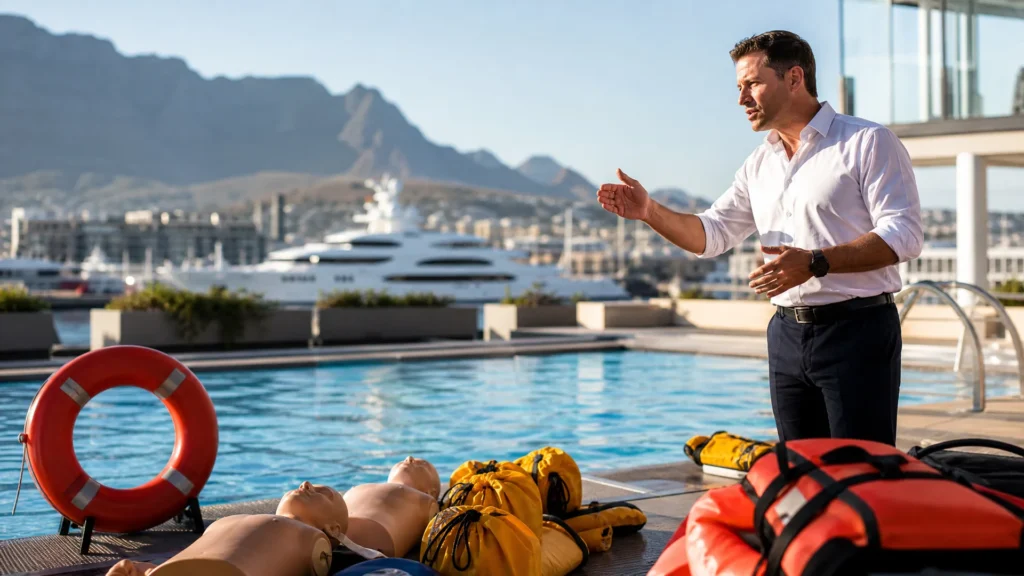
If you’re weighing up where to start your superyacht career, the training location matters as much as the certificate itself. Superyacht STCW courses in Cape Town give aspiring crew a practical, affordable way to earn the same internationally recognized qualification demanded on yachts everywhere. You skip the inflated costs of a Mediterranean base. Here’s what to expect before you book a course.
Why Cape Town Is a Smart Place to Start Your STCW Journey
Cape Town has grown into one of the southern hemisphere’s most active superyacht hubs. Vessels arrive each year for refit work, seasonal charters, and Atlantic crossings. That traffic has built up real maritime training infrastructure to match.
For newcomers, that’s a huge advantage. You get access to proper training pools, safety equipment, and experienced instructors, all at a fraction of what the same course costs in Europe. The exchange rate works strongly in favor of international students, so your budget stretches further without cutting corners on quality.
Access to Yachts, Marinas, and the Wider Industry
Training in Cape Town also puts you close to the boats themselves. Cape Town’s V&A Waterfront and Simon’s Town marinas host a growing seasonal superyacht refit and charter fleet. Newly certified crew get direct access to networking and dockwalking opportunities right after training.
That proximity matters. Instead of flying home after your course and starting your job search from scratch, you can walk the docks, meet crew, and start building industry contacts while your certificate is still fresh.
What Is STCW Basic Safety Training and Why Every Crew Member Needs It
STCW stands for Standards of Training, Certification and Watchkeeping. It’s not a superyacht-specific rule. The International Maritime Organization administers the STCW Convention, which sets the baseline safety training requirements for every crew member on a commercial vessel worldwide, including superyachts. Learn more about the convention directly from the International Maritime Organization.
In practice, this means no captain can legally put you to work on a commercial yacht without proof of STCW Basic Safety Training. It’s the entry ticket to the industry, full stop.
Who Requires STCW Certification
Every crew member needs STCW certification, regardless of the role they’re chasing. Deckhands need it. Stewardesses need it. Engineers, chefs, and even junior officers need it before they set foot on a working vessel.
There’s no experience exemption and no shortcut around it. If you want to work on a commercial superyacht, STCW basic safety training in Cape Town or elsewhere is the first item on your checklist.
STCW Modules Breakdown for Superyacht Crew
STCW Basic Safety Training is built around four core modules, each with a mix of classroom theory and hands-on practical assessment. SYTA runs superyacht-focused STCW Basic Safety Training in Cape Town designed specifically around the expectations of yacht crew, not generic commercial shipping standards. That distinction matters more than most first-time applicants realize.
Generic commercial STCW training is often geared toward cargo ships and large crews with rigid departmental roles. Superyacht crew work in tighter teams, with more crossover between deck and interior duties. Instruction that reflects yacht-specific scenarios prepares you far better for your first job. For a closer look at what each session actually covers, see this full breakdown of the STCW Basic Safety Training course.
Firefighting and Sea Survival
The firefighting module puts you through real fire suppression drills. You learn how to identify fire classes and use extinguishers and hoses correctly under pressure. It’s physical, hands-on, and built to create muscle memory rather than just theory.
Sea survival covers what happens if you ever need to abandon ship. You’ll practice life raft deployment, personal flotation techniques, and group survival procedures in open water, usually in a pool or sheltered training facility.
First Aid and Security Awareness
The first aid module teaches CPR, wound management, and how to respond to common shipboard injuries before professional medical help arrives. A yacht at sea can be genuinely isolated, so this training carries real weight. You can read about STCW first aid requirements in more detail if you want to understand what the assessment involves.
Security awareness rounds out the four modules. It introduces ISPS Code basics like restricted area access, suspicious activity reporting, and general vessel security protocol. For crew heading into charter or commercial roles, this module connects directly to the ISPS security awareness training for crew that many yachts require as standard.
What to Expect from the STCW Course Schedule and Format in Cape Town
STCW courses in Cape Town typically run over several consecutive days, combining morning classroom sessions with afternoon practical drills. The pace is intensive but manageable, even for students with no maritime background.
Expect small group sizes, which means more individual attention during pool sessions and firefighting drills. Instructors assess you continuously throughout the course rather than relying on a single final exam. Steady participation matters more than last-minute cramming.
Most students find the practical sessions the most memorable part. Suiting up for a fire drill or jumping into a life raft simulation is a world away from sitting through a slideshow. It’s genuinely useful preparation for life at sea.
STCW Cost and Time Commitment in South Africa vs. Other Regions
One of the most common questions from prospective crew is how long STCW takes in Cape Town. Most courses run as a compact, multi-day block rather than being spread out over weeks. You can complete the full certification in a single short trip.
On cost, South Africa consistently comes in below what students pay for equivalent STCW training in Europe or the United States. The favorable exchange rate, combined with lower local operating costs for training providers, means your certification fee goes further without any compromise on the qualification itself. The certificate you walk away with is the same internationally recognized STCW credential, valid on yachts anywhere in the world.
For many international students, that cost difference alone makes South Africa worth the flight. You get the same accreditation, delivered by instructors who understand the superyacht industry specifically, at a price that leaves more of your budget for the job search that follows.
How STCW Fits Into Your Superyacht Crew Qualifications Pathway
STCW is your starting point, not your finish line. It’s the mandatory baseline every crew member needs, but most captains and agencies also expect a few other basics before they’ll consider you for a role. If you want to see exactly what else sits on that list, check the full list of certifications required for every role.
Many aspiring stewardesses and deckhands choose to complete STCW and ENG1 medical checks in the same South African trip before flying to a yachting hub like Antibes or Palma to seek their first placement. That approach makes efficient use of your travel time and keeps your certifications aligned from the start.
What to Do Immediately After Completing Your STCW
Once you’ve got your STCW certificate in hand, the ENG1 medical certificate should be next on your list. It’s a standard requirement for most crew positions and easy to arrange while you’re already in Cape Town.
From there, focus on your job search materials. It’s worth taking time to polish your CV before applying for your first job, since agencies and captains often make snap decisions based on a one-page document. If you’re starting with zero maritime background, it also helps to understand how to start a yacht career with no experience so you know what realistic first roles look like.
STCW on its own can get your foot in the door for some entry-level roles. Pair it with additional short courses and a strong CV, though, and you’re well ahead of other first-time applicants competing for the same junior positions.
If you’re ready to take the first real step toward a superyacht career, Cape Town offers one of the most practical, cost-effective places to do it. You can also enroll in a Deck-Stew Career Course that includes STCW if you’d rather combine your basic safety training with broader entry-level preparation from day one. Whichever route you choose, use Find a Course to compare your options and get your training booked.