
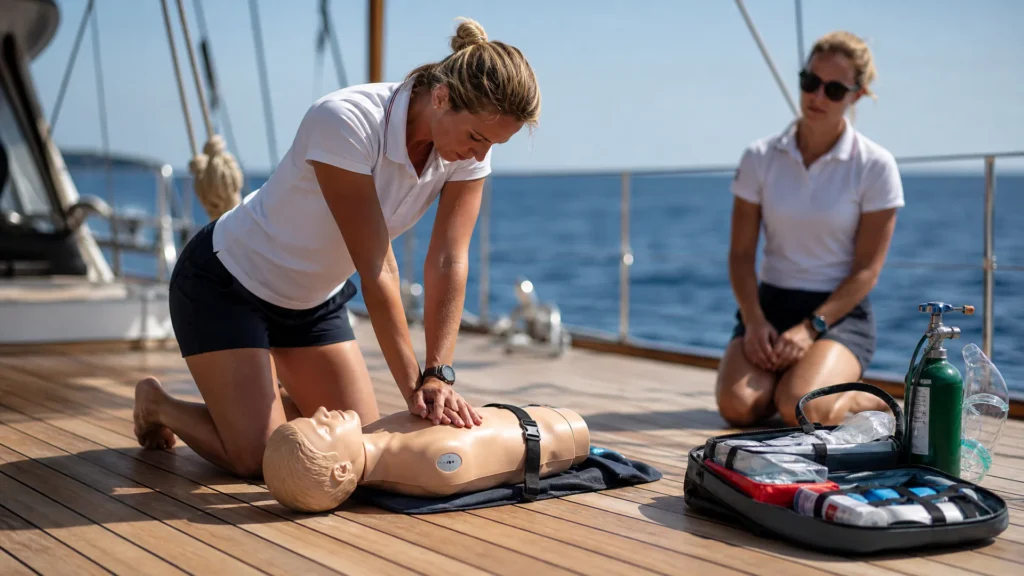
Yacht crew first aid certification is not optional in the superyacht industry, it is a professional baseline and, in most cases, a legal requirement. When a medical emergency strikes 200 nautical miles offshore, the nearest hospital is irrelevant. The crew on deck are the only first responders available, and how well they perform in those first minutes can determine whether a guest or colleague survives. That reality shapes everything about how superyacht medical training is designed, and why it demands more than a standard high-street first aid course.
Why First Aid Certification Is Non-Negotiable for Yacht Crew
Superyachts operate on remote ocean passages, far from emergency services and often outside the range of rapid medevac. A medical event that would be routine ashore, a severe allergic reaction, a cardiac episode, a diving injury, becomes a high-stakes isolation scenario when your vessel is days from port.
Maritime medical emergencies also unfold differently from land-based ones. Crew must assess, treat, and manage patients with limited equipment, no specialist backup on deck, and the added pressure of guest-facing responsibility. There is no ambulance to call. There is no handing off to a paramedic crew at the door.
First aid certification is also a regulatory requirement for any professional working aboard a commercial vessel. Charter yachts and commercially operated superyachts are subject to flag state regulations and international maritime conventions, and certified medical competence is embedded in those frameworks. Crew who cannot demonstrate compliance cannot be employed on compliant vessels.
Regulatory Requirements: STCW and Offshore Medical Certification
The international framework governing seafarer training is the STCW Convention, Standards of Training, Certification and Watchkeeping, administered by the International Maritime Organization. For a full breakdown of how these requirements apply to superyacht crew, see the complete guide to STCW certification for superyacht crew.
What STCW Mandates for Maritime First Aid
STCW Basic Safety Training (BST) is the mandatory entry point for any crew member serving on a commercial vessel over 24 metres. BST covers four core areas: personal survival techniques, firefighting and fire prevention, elementary first aid, and personal safety and social responsibilities.
Elementary first aid, the medical component within BST, covers immediate response skills: managing bleeding, recognising shock, performing CPR, and responding to casualties until further care is available. It is a prerequisite, not a specialisation, and every crew member working on a commercial superyacht must hold it before joining a vessel.
Additional Offshore Medical Certification for Senior Crew
STCW also mandates more advanced medical training for crew who hold designated medical duties. Two certifications sit above BST:
- Medical First Aid (MFA), required for crew who may need to provide medical first aid in the event of an accident or illness on board. This is typically relevant for deck officers and senior interior crew.
- Medical Care on Board (MCO), the highest-level medical certification under STCW, required for the person designated responsible for medical care on the vessel. MCO covers assessment, treatment, pharmacology, and coordination with external medical authorities.
Flag state requirements and MCA (Maritime and Coastguard Agency) compliance guidance influence which crew members must hold which level, but the principle is consistent: the more medical responsibility you carry, the more advanced your offshore medical certification must be.
Superyacht-Specific Medical Scenarios: Beyond a Standard First Aid Course
A generic first aid course teaches you to call 999. Yacht medical training teaches you what to do when calling anyone is not an option, or when help is still 36 hours away. That distinction matters enormously.
Isolation Protocols and Remote Medical Decision-Making
The greatest risk gap in superyacht crew preparedness is not a lack of knowledge about basic procedures. It is the confidence to make medical decisions alone, under pressure, when the crew member on deck is the most qualified person on board and evacuation is hours or days away.
Senior maritime medical instructors consistently identify this as the defining challenge of superyacht medical training. Quality crew safety training addresses it directly, through scenario-based decision-making exercises, telemedical communication drills, and protocols for liaising with shore-side medical teams by radio.
Guests on superyachts also present unique complications. They may have complex medical histories, be on prescription medication, or have conditions disclosed only in confidential pre-boarding documentation. Senior crew must be prepared to work with that information quickly and accurately.
Common Onboard Emergencies in the Superyacht Context
The medical emergencies most relevant to superyacht crews are shaped by the environment and the activities guests pursue:
- Anaphylaxis, a severe allergic reaction requiring immediate epinephrine administration. A chief stewardess crossing the Atlantic is typically the vessel’s designated first medical responder. She must be capable of managing anaphylaxis, administering epinephrine from the ship’s medical kit, and coordinating with a telemedical service before the nearest port is within reach.
- Cardiac events, CPR and AED competence is essential; response time on a vessel depends entirely on crew readiness.
- Dive-related injuries, decompression sickness is a distinctive superyacht hazard not covered by generic shoreside first aid courses. Crew trained in maritime first aid learn to stabilise a diver and coordinate evacuation to a hyperbaric facility.
- Trauma from water sports, lacerations, fractures, and head injuries are common in an active charter environment.
None of these scenarios are adequately covered by a basic community first aid course. That is why specialist yacht medical training exists.
Crew Safety Training on Yachts: Which Certification Is Right for You?
The right certification depends on where you are in your career. There is a clear progression, and getting onto the right track early makes a measurable difference.
Entry-Level Crew: Elementary First Aid as Part of STCW BST
If you are new to yachting, STCW Basic Safety Training is your starting point. It includes elementary first aid as one of its four mandatory components, giving you a regulated, internationally recognised medical baseline before you step aboard. If you’re considering how to break into the superyacht industry with no maritime experience, BST is the first certification you need to secure.
Entry-level crew do not need to hold MFA or MCO immediately, but understanding the progression matters, your career will move faster if you plan your certification pathway from the start.
Experienced and Senior Crew: Medical First Aid and Medical Care on Board
Deck officers, chief stewardesses, and any crew member assigned formal medical duties need to move beyond BST. For deck crew career progression and certifications, MFA is a standard milestone on the path toward officer roles.
Chief stewardesses carry significant medical responsibility. They typically manage the vessel’s medical kit, act as first responder for guests, and make treatment decisions in high-pressure, time-critical situations. Chief stewardess training and leadership certifications increasingly treat this medical competence as a core professional skill, not a secondary consideration.
For anyone in or approaching a vessel command or senior officer role, MCO is the benchmark that flag states and responsible owners expect.
What to Expect from a Maritime First Aid Course for Superyachts
Superyacht-focused maritime first aid courses go well beyond classroom theory. Expect:
- Scenario-based simulations replicating real onboard emergencies, situations specific to the yacht environment, not generic casualty scenarios
- CPR and AED training to a standard that reflects the absence of backup responders
- Wound management and patient assessment under conditions that simulate resource limitations
- Pharmacology basics at MCO level, including medications carried in a regulated ship’s medical kit
- Radio communication protocols for coordinating with telemedical support services
At Superyacht Training Academy (SYTA), all safety and certification programmes are designed around the operational realities of superyacht service. SYTA’s programmes, based in Cape Town, prepare crew for the isolation, guest-facing pressure, and multi-role responsibility that define the superyacht environment.
Explore the full range of superyacht crew training courses offered by SYTA to find the right certification for your current career stage.
Keeping Your Yacht Medical Training Current: Renewal and Career Progression
STCW certificates are not permanent. They carry renewal cycles, and crew who let certifications lapse risk being grounded, unable to board a commercial vessel until compliance is restored. Building a certification calendar is a practical necessity, not an administrative afterthought.
Renewal requirements vary by certificate and flag state, but the principle holds: medical competence must be demonstrated at regular intervals. This matters for compliance and for confidence, practical skills need refreshing, and medical protocols evolve.
From a career perspective, documented and current medical certification increasingly differentiates candidates in a competitive hiring market. Captains and chief officers expect crew to arrive with verified credentials. Superyacht fleets have continued growing through 2026, and the supply of fully safety-credentialed crew has not kept pace with demand.
Treating your yacht crew first aid certification as a career investment, not a one-time box-ticking exercise, is the mindset that separates professional crew from those who stall at entry level.
Ready to find the right course? Browse superyacht crew training courses and take the next step in your certification pathway. Not sure which level is right for you? Contact SYTA directly to discuss your career stage and the certifications that will get you where you want to go.