
Superyacht Engineer Training: High-Demand Career Path
Superyacht engineer training is one of the least-discussed but most in-demand pathways into the yachting industry. Deck and interior roles attract most of the entry-level attention, but the engineering department keeps every system on board running, and captains know it. If you have a technical background and want a career that combines serious responsibility with world-class travel, the engine room is worth a hard look.
What Does a Superyacht Engineer Actually Do?
Engineering vs. deck and interior roles
The deck department handles navigation, seamanship, and guest water activities. The interior department manages hospitality, service, and housekeeping. The engineering department manages everything that makes those two departments possible.
Engineers don’t serve guests and they rarely stand a helm watch. They own the mechanical and electrical health of the vessel, often working odd hours to fix something before a charter guest notices there was a problem. For career-changers who prefer solving problems over serving cocktails, that distinction matters. See how the deck department is structured for a clear comparison of how the departments interact.
Typical responsibilities on a large yacht
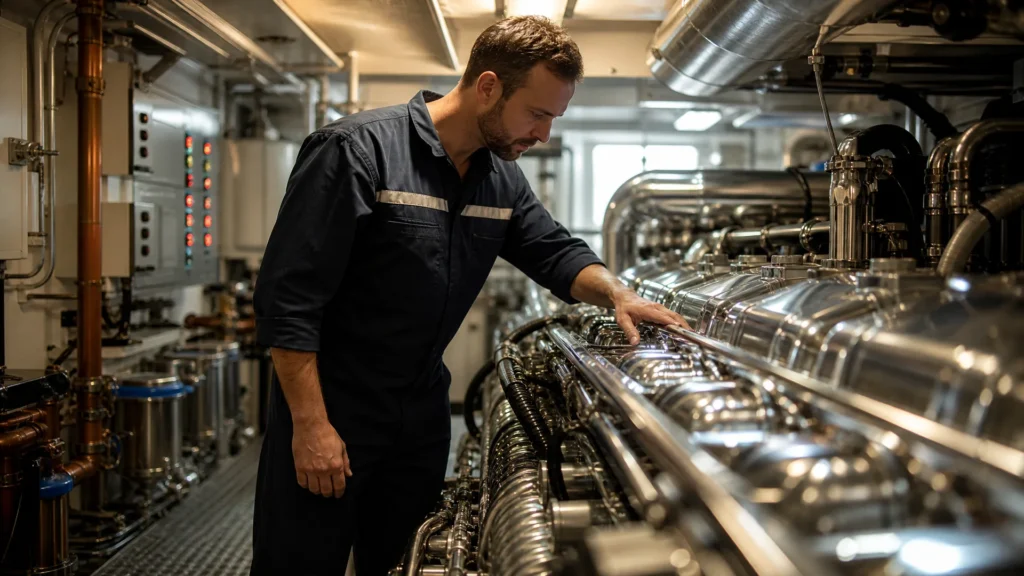
On a 60-metre motor yacht, the engineering department typically manages twin main engines, multiple generators, stabiliser systems, watermakers, HVAC, and a full complement of tender and water-toy machinery, a technical scope comparable to a small industrial facility.
A day underway might involve monitoring engine temperatures and fuel consumption, troubleshooting a watermaker fault, and servicing a tender outboard. In port, the work shifts toward scheduled maintenance: filter changes, system inspections, log entries, and liaising with shore technicians. There is rarely a quiet week.
Engineering Superyacht Careers: Ranks and Progression
Junior/assistant engineer
The entry point is typically a junior engineer or motorman role. At this level, you work under the supervision of a senior engineer or chief, learning the vessel’s specific systems while completing routine maintenance tasks. Vessels below 500 GT may carry only one engineer; larger yachts create space for a structured team with defined junior roles.
Progression from junior to second engineer depends on accumulated sea service, certification advancement, and demonstrated competency. Many junior engineers move through the ranks within three to five years, depending on how aggressively they pursue certificates and manufacturer training.
Yacht chief engineer
The yacht chief engineer heads the department, responsible for all engineering systems, the engine-room budget, and the vessel’s safety and maintenance compliance. On yachts of 50 metres and above, the chief often manages one or more assistant engineers and reports directly to the captain.
The role requires a higher level of flag-state certification than junior positions, which is why building the right certificate stack early matters. The rank you hold determines the certification you need, and the certification you hold opens the next rank.
Superyacht Engineer Training: Core Certifications You Need
STCW as the mandatory baseline
Every person working at sea on a commercial yacht must hold a valid STCW Basic Safety Training certificate. The complete guide to STCW certification for superyachts covers this in full, but the core package includes:
- Personal Survival Techniques
- Fire Prevention and Fire Fighting
- Elementary First Aid, see first aid certification requirements for yacht crew for more detail
- Personal Safety and Social Responsibilities
These four elements are non-negotiable regardless of department. Without them, no flag state will issue an endorsement and no reputable crew agent will put you forward for a berth.
MCA / flag-state endorsements and EOOW
Beyond STCW basics, superyacht engineer training follows the watch-keeping pathway set out by the flag state. The MCA’s Large Yacht Code (LY3) sets out engineering watch-keeping requirements that apply to commercial yachts above 24 metres, meaning the certification bar for superyacht engineers is set by the same authority that governs large commercial ships.
The key engineering progression under this framework runs toward the Engineer Officer of the Watch (EOOW) certificate, sometimes referenced as OEOW. This qualification allows an engineer to stand an unsupervised engineering watch, which is the threshold requirement for senior officer berths on larger vessels.
The specific certificate names and tonnage thresholds vary by flag. Cayman Islands, Marshall Islands, and British registers all have slightly different requirements, so confirming requirements against your target flag state early saves wasted course investment.
Yacht systems training: manufacturer and OEM courses
Once mandatory certificates are in order, specialist yacht systems training is what separates competitive candidates from average ones.
OEM-certified training on engines such as MTU or Caterpillar, or on stabiliser systems by Naiad or Quantum, is widely sought by captains and managers because it reduces costly yard time and third-party call-outs. When a chief engineer can diagnose and resolve a stabiliser fault without flying in a specialist, the vessel saves significant time and money. Captains know this, and they hire accordingly.
Engineers who hold both their mandatory flag-state tickets and at least one manufacturer certification consistently field more interview requests and command stronger starting packages. The technical specificity signals readiness to work unsupervised. Relevant areas to prioritise include:
- Main engine OEM training (MTU, Caterpillar, MAN)
- Generator systems (Onan, Northern Lights)
- Watermaker and reverse osmosis systems
- HVAC and refrigeration
- Marine electrical systems
No single engineer holds every certificate, but building a focused skill set around a vessel type or engine brand accelerates hiring.
Marine Engineer Superyacht Salary and Lifestyle Expectations
Engineers are among the highest-paid crew on any vessel, reflecting the technical complexity of the role and the cost of failures in their department. Chief engineers on large motor yachts earn salaries that place them in the upper tier of the crew pay structure, and junior engineers typically earn more than equivalent-ranked deck crew on the same vessel.
Beyond base salary, the live-aboard lifestyle eliminates most personal expenses, accommodation, food, and transport are covered while on board. Tips on private charters add meaningfully to annual income, particularly on high-utilisation yachts operating in the Mediterranean and Caribbean seasons.
The lifestyle suits people who are comfortable with schedule unpredictability. Rotations vary by vessel, but engineers generally work the same patterns as senior officers. Extended leave between contracts is common and creates space for additional training. For a broader view of how engineering pay compares across departments, the superyacht interior crew salary guide provides a useful department-by-department reference.
How to Get Started: Building Your Superyacht Engineering Career in 2026
Background that transfers well
The superyacht industry actively recruits from technical trades. Backgrounds that translate well include:
- Marine or merchant navy engineering, the most direct transfer, often with existing STCW and sea service
- Mechanical and diesel engineering, strong engine-room fundamentals, though maritime familiarisation is needed
- Electrical and automation trades, increasingly valuable as yachts add complex integrated systems
- Automotive, HGV, and plant mechanics, practical maintenance skills transfer directly
- Military engineering, disciplined approach to maintenance schedules and technical documentation
If you’re breaking into the superyacht industry with no maritime background, a strong trade background is your primary asset. Expect to invest in maritime-specific certification before agencies take you seriously for engineering berths.
Plotting your first steps
A realistic first-step checklist for 2026 looks like this:
- Complete STCW Basic Safety Training, the mandatory foundation for any commercial yacht role
- Obtain your ENG1 medical certificate, required before stepping aboard a commercial vessel
- Research flag-state requirements for the vessel size you’re targeting (below or above 3,000 GT changes the certificate pathway)
- Build sea-service hours, even day work in a boatyard or superyacht marina counts toward your logbook
- Pursue a junior engineering berth, crew agents and dockside networking are both effective; Cape Town is an active crew placement hub, particularly during the pre-season period when yachts transit through
- Plan your first OEM course, identify the engine brand most common in your target vessel class and book manufacturer training early
The engineering pathway rewards methodical planning. Each certificate and each logged sea-service hour is a concrete step toward a senior berth.
Ready to take the first step? Explore superyacht crew training courses at Superyacht Training Academy and find the STCW and engineering programmes that match where you are right now. The engine room is hiring, and the candidates who arrive with the right tickets get there first.