
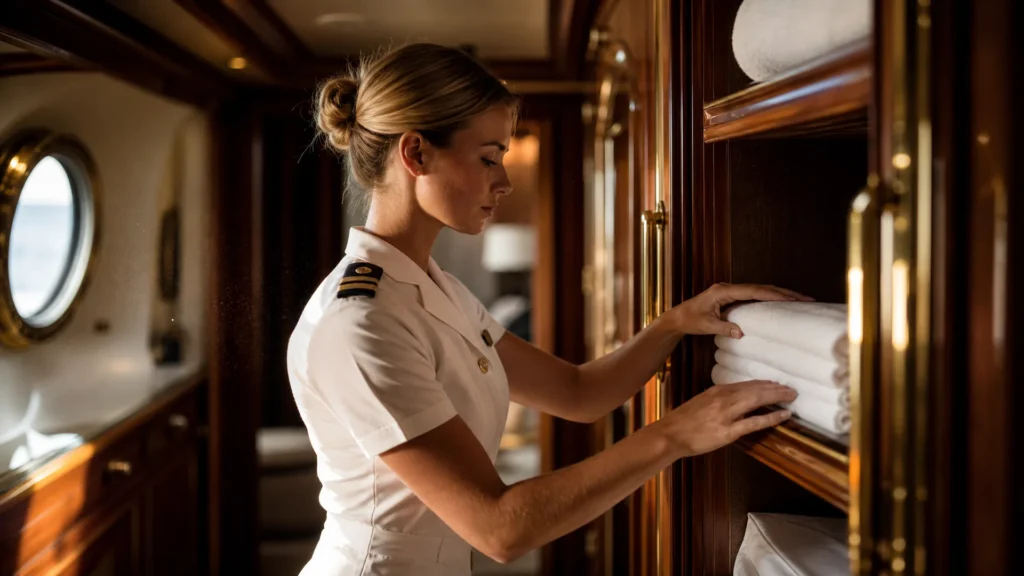
Superyacht Interior Crew Salary: Ranks, Rates & Benefits
Superyacht interior crew salary is one of the most searched, and least clearly answered, questions for anyone considering a career on the water. Figures circulate online, but they’re often out of date, stripped of context, or lumped together across very different vessel sizes and roles. This guide breaks it down by rank, yacht size, and experience level so you can build an accurate picture before you take your first step into the industry.
Why Superyacht Interior Crew Salary Stands Apart from Hospitality Ashore
The headline monthly figure is only part of the story. Interior crew live aboard the vessel, so there is no rent, no grocery bill, and no daily commute. Uniforms are provided. Meals are covered. On well-run programmes, health insurance is included. Strip those costs out of a land-based hospitality salary and the purchasing power of a superyacht wage is substantially higher than the number on the contract suggests.
That context changes how you evaluate offers. A monthly base pay that looks modest in isolation is almost entirely disposable income, a dynamic that few shore-based roles can match at equivalent seniority levels.
Figures do vary. Yacht size, flag state, whether the vessel runs on charter or private rotation, and the owner’s overall budget all influence what interior crew are paid. The sections below unpack each of those variables.
Salary by Role: From Entry-Level Stewardess to Chief Stew
Junior Stewardess / Steward
The junior stewardess or steward role is the recognised entry point for interior crew with no prior maritime experience. On vessels in the 30–50 m range, monthly base pay typically starts around $2,500–$3,500 USD, though this shifts with flag state and specific yacht management policies.
The baseline requirement before stepping aboard is STCW certification for superyacht crew, the international safety standard that no yacht crew member can work without. Candidates who arrive with additional hospitality training tend to negotiate stronger starting figures and move more quickly to senior rank.
Senior Stewardess / Steward
After two seasons of solid experience, or sometimes just one, with the right certifications and a vessel move, interior crew can step into a senior stewardess role. On a 40–60 m yacht, monthly pay at this level typically falls in the $3,500–$5,000 USD range, reflecting the added responsibility for cabin management, guest service standards, and junior crew supervision.
A stewardess moving from a 35 m sailing yacht to a 55 m motor yacht after one full season, with added wine and beverage certification, can realistically target a senior stewardess title and the corresponding pay step within that single move. The title shift and pay increase often happen together when crew change vessels rather than waiting for internal promotion.
Chief Stewardess Yacht Pay
Chief stewardess yacht pay represents the most significant jump in the interior crew hierarchy. On a 60 m+ vessel, the chief stew manages a team of three to five interior staff, controls provisioning budgets, owns the guest experience from arrival to departure, and is the owner’s primary point of contact for all interior operations.
That operational scope is comparable to a hotel front-of-house manager, and the pay reflects it. Monthly base figures at this level on large-to-mega yachts range from $6,000 to $10,000+ USD depending on vessel size and programme intensity.
The title housekeeper yacht wages appears on some privately owned vessels, particularly in European and Middle Eastern fleets, as an equivalent designation for senior interior crew managing private residences aboard. The compensation structure is broadly comparable to chief stewardess roles at equivalent vessel sizes.
How Yacht Size Shapes Superyacht Crew Earnings
Vessel length is the single strongest predictor of interior crew pay at every rank. Larger yachts carry larger operating budgets, more demanding guest programmes, and more complex interior departments, all of which push base pay upward.
In broad terms, the market operates across four bands:
- Sub-40 m: Smaller crew manifests, multi-tasking roles, entry-level to junior-mid pay. These berths are excellent for building experience but rarely offer top-tier salaries.
- 40–60 m: A step up in budget and specialisation. Senior stewardess and second stew roles come into their own here, with pay that starts to reflect genuine professional seniority.
- 60–80 m: Chief stewardess positions carry significant management weight. Interior teams of four to six are common, and base pay at every rank reflects the programme complexity.
- 80 m+ (explorer and mega): The top of the market. Pay scales here are competitive with mid-to-senior hospitality management ashore, before factoring in the live-aboard benefit stack.
Charter vessels add another income layer on top of base pay. Gratuities on charter yachts are conventionally estimated at around 10–15% of the weekly charter fee, divided among the crew. On a high-volume charter programme, this can add a meaningful four-figure monthly sum to an interior crew member’s effective income, making charter berths on busy programmes among the highest-earning positions in the industry, particularly for experienced interior crew.
For context on how interior pay compares across departments, how deck crew salaries and progression compare is worth reading alongside this guide.
Beyond the Base: Benefits That Boost Total Superyacht Crew Earnings
The full compensation package looks different once the live-aboard structure is factored in. It eliminates costs that consume a large share of most workers’ take-home pay:
- Accommodation: Covered entirely by the yacht.
- Food: All meals provided aboard, including when in port on many programmes.
- Uniforms: Purchased and maintained by the vessel.
- Travel: Join and departure flights to and from the yacht’s location are covered by most well-managed programmes.
- Health insurance: Included in crew agreements on reputable yachts and management companies.
- Rotational leave: On larger yachts, a 1:1 rotation (one month on, one month off) is standard, giving crew substantial paid time ashore without salary deduction.
A crew member earning a mid-range monthly base and spending almost nothing on living costs accumulates savings at a rate that most shore-based hospitality professionals cannot match. That is central to why so many career-changers from hotels, restaurants, and retail make the move, and why they rarely go back.
Yacht Interior Staff Pay Across Experience Levels: What Moves the Needle
Certifications and Training
STCW is the legal baseline, you cannot work on a commercial vessel without it. But STCW alone does not differentiate you in a competitive candidate pool. What captains and yacht management companies screen for, beyond safety compliance, is demonstrable hospitality expertise.
Courses in wine and beverage service, silver service, table setting and etiquette, interior management, and guest experience all signal to hiring decision-makers that a candidate understands the standard expected on a high-end vessel. SYTA candidates who complete accredited interior hospitality training before their first season consistently report faster placement and better starting offers than those who arrive with STCW alone.
The Foundations of High-End Hospitality course is specifically designed to bridge that gap, turning motivated candidates into credible interior crew before they ever step on a gangway.
If you’re new to the industry entirely, how to get into superyachts with no maritime experience maps the full entry pathway.
Vessel Type: Private vs. Charter
Private yachts and charter yachts offer different income profiles, and the right choice depends on what a crew member values most.
Charter yachts are busier operationally, back-to-back guest rotations, high service intensity, and gratuity income that can substantially lift monthly earnings. For motivated crew who want to build experience fast and maximise take-home pay in the short term, charter programmes are often the stronger choice.
Private yachts tend to offer greater operational consistency, closer relationships with a single owner and their preferences, and sometimes a higher base pay to compensate for the absence of gratuity. The pace is typically more measured, which suits crew prioritising stability and longer-term placement.
Seasonal versus permanent contracts also affect annual income. A seasonal crew member earns more per month during the active season but may carry employment gaps in the off-season. A permanent contract provides year-round income, and on larger privately owned yachts, permanent berths with strong base pay and full benefit packages are among the most financially secure positions available to hospitality professionals at any level.
Realistic Earning Expectations for 2026 and How to Maximise Them
Entering the industry in 2026, treat your first season as an investment. Entry-level pay on a smaller vessel may not be the headline figure you were hoping for, but the career compression available in superyachting is exceptional. Two seasons with the right certifications, the right vessel moves, and a proactive approach to skill development can take a complete newcomer to senior stewardess level and the pay that comes with it.
The global fleet of superyachts over 24 metres has expanded steadily year on year, and 2026 order books at major European shipyards remain strong. That sustains above-average demand for qualified interior crew relative to supply, and that imbalance works in favour of well-prepared candidates, particularly those who can demonstrate formal hospitality training alongside their STCW.
Career-changers from hotel front-of-house, restaurant service, or events backgrounds often reach senior stewardess level within two seasons, sometimes faster, because their service instincts translate directly. The gap between where most candidates start and where they can realistically be within 18–24 months is narrower in superyachting than in almost any comparable hospitality career.
If this guide has confirmed the move is right for you, the logical next step is building the credentials that move you ahead of the competition. View all superyacht crew training courses at SYTA and find the programme that fits your starting point.