
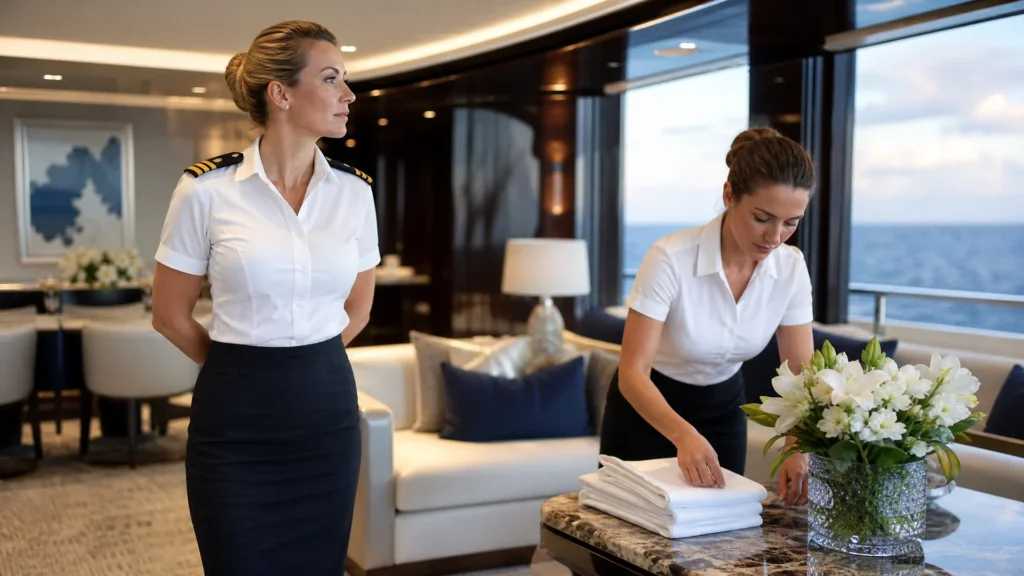
Stepping into the role of chief stewardess on a superyacht is not a natural extension of being a great stew, it’s a professional step change. Superyacht chief stewardess training exists precisely because the skills that make someone an exceptional junior crew member are not the same skills that make someone an effective interior officer. If you’re working toward that rank, the right certifications and leadership preparation are what separate candidates who get hired at the officer level from those who wait years for the break they’re hoping for. Explore the full range of superyacht crew training courses to see how chief stew preparation fits into the broader qualification pathway.
What Does a Chief Stewardess Actually Do?
The chief stewardess is an officer-level role. That distinction matters, because the day-to-day demands go well beyond service delivery.
Leadership responsibilities beyond service
On vessels above 40 metres, a chief stewardess routinely manages a team of three to six interior crew, coordinates multi-course formal dining for ultra-high-net-worth guests, and oversees provisioning budgets that can run to tens of thousands of dollars per charter week. Those responsibilities are closer to a boutique hotel manager than a service attendant.
The chief stew sets the standard for every guest interaction on board. She, or he, writes service schedules, trains junior crew on protocols, manages guest preference profiles, and liaises directly with the captain and chief officer on all interior matters. When something goes wrong with a guest experience, it lands on the chief stew’s desk.
Interior management and crew oversight
Interior management on a superyacht is a continuous operational process, not a set of tasks. It means running pre-charter briefings, maintaining laundry and housekeeping SOPs, managing uniform standards, coordinating with the chef on dining service, and keeping detailed inventory records.
A chief stew is also a line manager. Conflict between crew, performance issues, fatigue management under tight turnarounds, these are the chief stew’s responsibility to handle calmly and professionally. Generic hospitality training doesn’t touch any of this. That’s why the officer-level interior credential exists.
Why Standard Stewardess Training Isn’t Enough
Entry-level interior training gives you the foundations: silver service, wine knowledge, cabin preparation, safety procedures. That knowledge is essential, but it only qualifies you to execute tasks under someone else’s direction.
The gap between junior crew and interior officer
The jump from senior stewardess to chief stew is the largest single skills gap in the interior career pathway. You stop doing and start directing. You stop following the schedule and start writing it. You stop reporting problems and start solving them.
Most crew who stall at senior stew level have the service skills. What they’re missing is the systems thinking, the management frameworks, and the confidence to lead a team under pressure. Those are learned capabilities, not intuitions, and they’re what advanced certification is designed to build.
What advanced stewardess certification covers
Advanced stewardess certification moves beyond technique into leadership, operations management, and interpersonal skills. A course built for officer-readiness covers how to structure crew briefings, how to manage inventory at scale, how to run a housekeeping programme across multiple guest cabins simultaneously, and how to handle the human dynamics of a small, confined team working long hours.
The distinction between entry-level interior crew training and advanced stewardess certification is the difference between knowing what good service looks like and being able to deliver it consistently through a team, at the standard five-star guests on charter yachts expect every time.
Core Competencies Covered in Chief Stewardess Training
Superyacht chief stewardess training is structured around practical, officer-level competencies, not theoretical frameworks imported from shore-based hospitality.
Interior management and superyacht housekeeping supervision
Housekeeping supervision at sea is more demanding than ashore because turnarounds are compressed and the team is small. Chief stew training covers housekeeping SOPs for different vessel configurations, linen and laundry management systems, cabin inspection standards, and how to maintain consistent output across a rotating crew roster.
Provisioning is a core module: budgeting for charter rotations, managing supplier relationships across different ports, tracking stock levels, and minimising waste. These are financial and logistical skills that take time to develop without structured guidance.
Formal table service management, setting standards for multi-course dining, training crew on mise en place, overseeing wine and cocktail service, is a practical skill that interior officers are expected to have mastered and be able to teach.
Leadership development for yacht crew
Leadership development in a superyacht context is specific. It accounts for the confined living environment, the hierarchical crew structure, the direct exposure to UHNW guest demands, and the physical intensity of back-to-back charter programmes.
Chief stew training addresses conflict resolution within a small interior team, how to give effective feedback without damaging morale, how to run a pre-charter crew briefing that actually sticks, and how to maintain authority and approachability at the same time. The common failure points for newly promoted chief stewardesses, managing interpersonal conflict, holding housekeeping standards under turnaround pressure, running effective crew briefings, are precisely the scenarios that structured leadership training addresses before they become on-board problems.
Certifications That Matter for Interior Career Advancement
Every working crew member on a commercially certified vessel needs their STCW certification requirements for superyacht crew in order. STCW is the non-negotiable baseline, it covers safety, first aid, firefighting, and survival, but it says nothing about your competency as an interior officer.
Above STCW, advanced stewardess certifications signal officer-readiness to the captains and chief officers making hiring decisions. Captains and chief officers consistently report that candidates with documented leadership and interior management training stand out, because soft skills and systems knowledge are hard to assess from a CV alone. A structured credential removes that uncertainty.
MCA-recognised qualifications carry particular weight on commercially operated vessels working under the Large Yacht Code, because they demonstrate alignment with the regulatory framework the vessel operates in. When you’re being considered for a chief stew position on a charter yacht, having MCA-relevant credentials alongside your STCW makes the hiring decision straightforward.
Documented training also compresses promotion timelines. Crew who complete advanced interior certification while still working as senior stewardesses arrive at chief stew interviews with credibility their experience alone doesn’t yet give them.
Career Progression: From Stewardess to Chief Stew
The interior career pathway follows a clear structure: junior stewardess → senior stewardess → chief stewardess. The timeline depends on the vessels you work, the programmes you complete, and how deliberately you pursue the next rank.
Most crew move from junior to senior stewardess within one to two seasons of active work on a well-run interior team, assuming they’re building their skills and seeking out formal training alongside their sea time. The jump from senior to chief stew typically takes longer, two to four years for most people, because the role requires demonstrated management competency, not just accumulated service hours.
Formal training accelerates that timeline by giving you the frameworks and credentials before you have the title. Captains hire for potential when they trust a candidate’s preparation. Understanding what chief stewardesses earn at each rank makes the ROI case for advanced training straightforward: the salary difference between a senior stew and a chief stew on a large charter yacht is substantial, and it compounds year over year.
If you’re still developing your service fundamentals, the foundations of high-end superyacht hospitality course is the right starting point before you move into officer-level preparation.
How SYTA’s Advanced Interior Training Sets You Apart
The superyacht fleet has grown steadily through the mid-2020s, driving sustained demand for qualified interior officers who can maintain five-star standards across back-to-back private and charter programmes. There are more chief stew positions to fill than there are candidates with the right credentials, which makes 2026 the right time to formalise your training.
SYTA is based in Cape Town and built specifically for the superyacht industry. The instructors are industry insiders, not generalist hospitality trainers. Every module is written for the context you’ll actually work in: the vessels, the guests, the operational pressures, and the crew culture of the superyacht world.
SYTA’s Advanced Stewardess Career Course is designed for crew who are already working in the interior, people with sea time who are ready to step into a leadership role and want the training and certification to back it up. It combines practical housekeeping systems, formal service protocols, provisioning management, and leadership skills in a superyacht-specific format that generic hospitality or maritime programmes don’t offer.
If the chief stewardess title is your next career goal, structured, niche training is your clearest path to it. Find a Course and take the step that sets you apart at your next interview.