
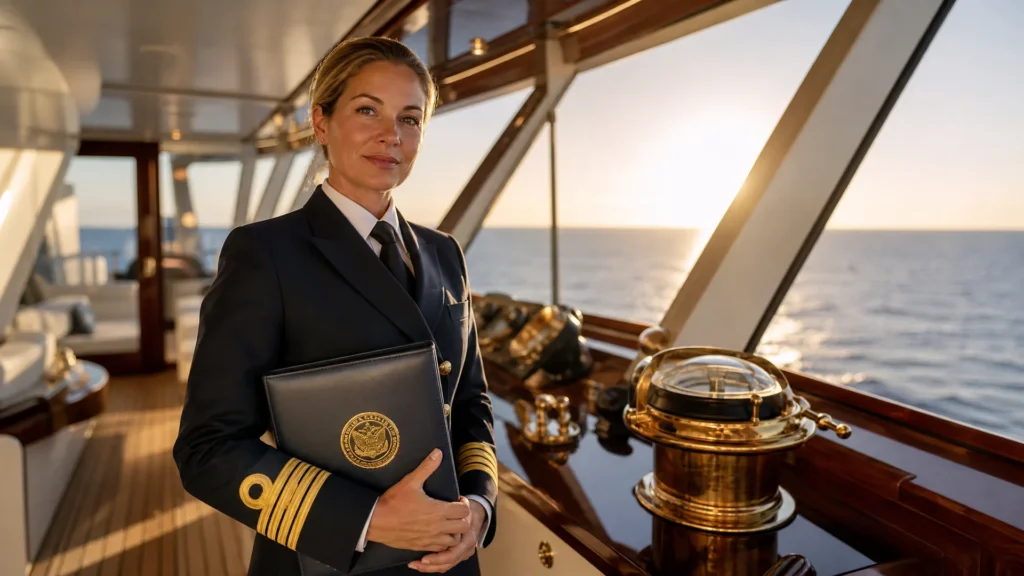
If you’re serious about working on superyachts, one credential sits at the foundation of everything else: STCW certification that every superyacht professional must carry before stepping aboard a commercial vessel. It is not a nice-to-have. It is a legal requirement under international maritime law, and without it, no captain, crew agency, or flag state will clear you to work. Understanding what STCW covers, how it applies to the superyacht world, and how to get certified is the clearest first step you can take toward a career on the water.
What Is STCW Certification and Why It Matters for Superyacht Crew
STCW stands for the Standards of Training, Certification and Watchkeeping for Seafarers. It is the international convention that sets minimum competency and safety standards for anyone working aboard a seagoing vessel. The International Maritime Organization (IMO) adopted STCW in 1978, revised it substantially in 1995, and strengthened it again through the 2010 Manila Amendments, the competency standards introduced then remain in force today.
Think of it as the industry-recognised passport every professional seafarer carries. Just as a commercial pilot cannot legally fly without type ratings and medical certificates, a superyacht crew member cannot legally work aboard a commercially operated vessel without a valid STCW certificate. The convention applies to merchant shipping, offshore vessels, passenger ferries, and superyachts operating commercially.
How STCW Standards Apply Specifically to Superyachts
Most STCW guides are written with cargo ships in mind. The superyacht industry has its own regulatory nuances, and understanding them matters.
Commercial vs. Private Yacht Operations
The core distinction is whether a yacht operates commercially or privately. A vessel used exclusively by its owner, not carrying paying guests or charterers, sits in a different compliance category from a yacht that earns revenue through charter. Commercially operated yachts must meet the full suite of STCW standards because they are, in legal terms, commercial vessels. The fact that guests arrive by helicopter rather than gangway is irrelevant to the flag state.
If you plan to work on a charter yacht, STCW certification requirements apply to you in full. If you crew a purely private vessel, some flag states apply lighter requirements, but in practice, virtually all professional crew on private yachts hold STCW certification anyway, because it is the benchmark the industry expects.
Flag State and MCA Large Yacht Code Considerations
The regulatory picture is layered. Beyond the IMO convention itself, individual flag states, the countries whose flags yachts fly, enforce compliance and issue seafarer certificates. On top of that, codes like the UK Maritime and Coastguard Agency’s Large Yacht Code (currently LY4) set out detailed crew certification requirements for commercially operated yachts over 24 metres. A smaller private yacht and a 60-metre charter superyacht face meaningfully different compliance obligations.
The practical implication: always check the specific requirements for the flag state of any vessel you plan to join, and confirm your certifications are recognised by that authority. An accredited training provider will walk you through this.
STCW Basic Training: The Mandatory Starting Point
Before you can join any commercially operated vessel, you must complete STCW Basic Safety Training. This is the non-negotiable entry point, crew placement agencies consistently flag it as the first certification to obtain before any superyacht job application. Vessels will not take on crew who cannot show a valid certificate.
The Four Core STCW Basic Safety Courses
STCW Basic Safety Training comprises four mandatory elements:
- Personal Survival Techniques, how to survive a vessel abandonment, including liferaft operation, distress signalling, and in-water survival.
- Fire Prevention and Firefighting, fire behaviour at sea, firefighting equipment, and practical fire suppression drills.
- Elementary First Aid, immediate response to injuries and medical emergencies before professional help is available.
- Personal Safety and Social Responsibilities, shipboard safety culture, watchkeeping obligations, and working within a vessel’s operational hierarchy.
All four modules must be completed before joining a vessel. They are typically delivered together as a single course block, and a crew member who completes all four can do so within five days, making STCW Basic Safety Training one of the fastest professional entry credentials in any maritime sector.
Validity, Revalidation, and Record of Sea Service
STCW Basic Safety certificates are valid for five years. Before expiry, you must revalidate, either by completing a refresher course or by demonstrating a sufficient Record of Sea Service, depending on flag state rules. Letting your certificate lapse is a career disruption you want to avoid, so build revalidation dates into your planning from day one.
Beyond Basic Safety: Additional STCW Certificates Superyacht Crew Need
STCW Basic Training gets you in the door. Working on a commercial superyacht, particularly a charter vessel, typically requires several additional modules that captains and crew agencies treat as near-universal expectations.
Proficiency in Security Awareness (PSA) and Designated Security Duties
The STCW security awareness certificate (sometimes called PSA) is required for all seafarers on vessels subject to the ISPS Code, which covers commercially operated superyachts. It covers threat recognition, access control, and reporting procedures. Crew assigned specific security responsibilities need the more detailed Designated Security Duties certificate. Both are straightforward to obtain alongside your Basic Safety training.
Crowd Management and Crisis Management for Charter Yachts
Charter yachts carry guests, and that changes the safety calculus. Crowd Management Training is mandatory for crew who deal directly with passengers in an emergency. Crisis Management and Human Behaviour Training goes further, preparing senior crew to manage emergency scenarios involving multiple people under stress. For anyone working in an interior or senior deck role on a charter superyacht, these certificates are standard expectations. They signal to an employer that you can protect guests, not just yourself.
Proficiency in Survival Craft (a higher-level liferaft and rescue boat qualification) is also routinely required for officers and senior crew.
Role-Specific Yacht Crew Certification Requirements
Understanding the broader framework is useful, but yacht crew certification requirements vary by role. Here is a practical map:
- Deckhands, STCW Basic Safety Training as the foundation, plus a Powerboat Level 2 or equivalent helm qualification and, for many vessels, a Personal Watercraft (PWC) licence. Security Awareness is also expected.
- Interior crew (stewards/stewardesses), STCW Basic Safety Training plus a Food Safety / Food Hygiene certificate. Crowd Management is expected on charter vessels. Some employers also look for a Wine & Beverage or Silver Service qualification.
- Engineers, STCW Basic Safety Training plus relevant engineering endorsements. Engine Room Resource Management and high-voltage training may be required depending on the vessel’s systems.
Each role has depth beyond this summary. For a full breakdown, explore the superyacht crew training courses at SYTA to match your target role to the right course pathway.
How to Get Your STCW Certification: Application Path for Superyacht Crew
Getting certified is more straightforward than many newcomers expect. The process follows a clear sequence.
Choosing an Accredited STCW Training Provider
The most important decision is picking a training provider approved by a recognised flag state authority, for example, the MCA in the UK. Not every course on the market meets this standard, and a certificate from a non-approved provider may not be accepted by a vessel’s flag state.
Beyond accreditation, look for providers whose courses are built for the superyacht environment. The scenarios, terminology, and guest-facing context of a superyacht differ from generic commercial-shipping programmes. Training built around a container ship’s crew culture will not prepare you as well for life aboard a 50-metre motor yacht. At Superyacht Training Academy, our STCW courses are structured for this environment, because the details matter when you are working with high-profile guests and a small, high-pressure crew.
If you are coming to this with no maritime background, it helps to read up on how to become superyacht crew with no maritime background before booking, it gives you a clear picture of the full journey ahead.
Costs, Timelines, and What to Expect
A full STCW Basic Safety package, all four core modules, is completable within a single five-day block. Many providers offer combined packages that add Security Awareness and Crowd Management in the same week, so you can arrive job-ready in under two weeks of training.
On completion, you receive a Basic Safety Training certificate. Depending on your flag state, you may also need to register your qualification with the relevant maritime authority. Your training provider will advise on this. Costs vary by provider and location, so compare a few accredited options, but prioritise quality and flag-state recognition over price.
Once certified, you are ready to apply. Find an accredited STCW course at SYTA and take the first step toward joining the superyacht industry with the credentials that matter.
STCW certification is not a bureaucratic hurdle, it is the foundation of a safe, credible, and employable career on the water. Get your Basic Safety Training completed, add the role-specific certificates your target position requires, and you will be applying for real positions with confidence. Browse SYTA’s full course catalogue and Find a Course that fits your role, your timeline, and your ambitions.