
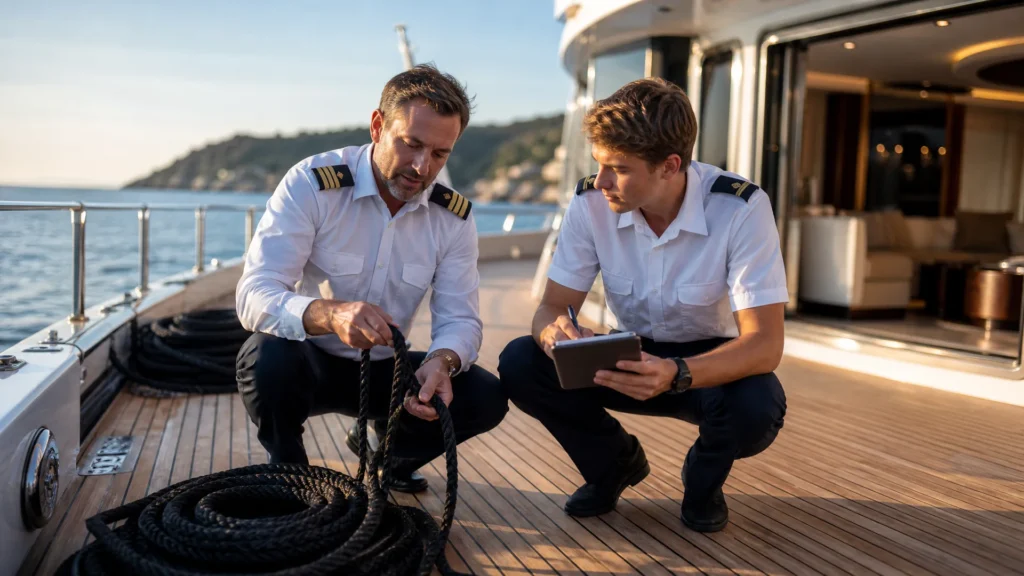
Superyacht Crew Training Courses
Choosing the right superyacht crew training courses is one of the most consequential decisions you’ll make when entering this industry. The market is full of maritime courses, but most are built for commercial shipping, not private charter and superyacht operations. Knowing the difference, and knowing what to look for in a training provider, puts you on a faster, cleaner path to getting hired.
Why Superyacht-Specific Training Courses Matter
General maritime qualifications give you a safety baseline. They do not prepare you for life aboard a 60-metre private yacht where a charter guest’s experience is the primary measure of performance.
Superyacht operations run on different standards. Guest service protocols, interior presentation, formal dining etiquette, and onboard hierarchy all reflect the luxury hospitality industry as much as commercial seafaring. A deckhand on a bulk carrier and a deckhand on a superyacht hold the same STCW certificate, but their working environments are worlds apart.
Dedicated superyacht crew training courses bridge that gap. They embed guest-facing standards, yacht-specific terminology, and realistic onboard scenarios directly into the curriculum. For captains and crew managers reviewing applications, that specialization is visible from day one.
What to Look for in a Superyacht Training Academy
Not all training providers are equal. When evaluating a superyacht training academy, a few criteria cut through the noise quickly.
Accreditation and Industry Recognition
Accreditation is non-negotiable. Look for MCA (Maritime and Coastguard Agency) approval and alignment with the STCW Convention, the international framework governing seafarer certification. The MCA’s Large Yacht (LY) Code sets tiered officer certification requirements specifically for commercially operated superyachts above certain tonnages. Officers on these vessels must hold MCA-recognized qualifications, not just standard STCW tickets.
Accredited yacht courses carry real weight with crew agencies and captains. Certificates from unrecognized providers may satisfy a checkbox on paper but raise doubts in practice. Check that any academy you consider is approved by the relevant flag state or maritime authority before enrolling.
Industry connections matter too. Academies with direct ties to crewing agencies and placement networks give you a practical advantage beyond the certificate itself.
Course Depth: Entry-Level vs. Career Progression
A quality superyacht crew academy offers a clear course ladder, from entry-level safety training through to officer-level qualifications. If a provider only offers one or two standalone courses with no progression pathway, that’s a limitation worth noting.
The best academies map their courses to career milestones: what you need to get your first job, what you need to qualify for promotion, and what unlocks officer roles. That structure lets you plan training alongside your time at sea, rather than retrofitting qualifications ad hoc.
Core Superyacht Crew Certification Courses Explained
STCW Basic Safety Training
STCW Basic Safety Training is the internationally mandated starting point for every crew member working aboard a commercial vessel, including superyachts. It covers four core areas: firefighting and fire prevention, personal survival techniques, elementary first aid, and personal safety and social responsibility.
No flag state, crew agency, or captain will put you on a vessel without a valid STCW BST certificate. It’s your entry ticket, but it’s only the beginning. STCW alone does not qualify you for a specific role or department. That’s where role-specific yacht crew certification courses take over.
Deck, Interior, and Engineering Pathways
Each department has its own certification track, and understanding which pathway applies to your target role is essential.
Deck: Entry-level deck crew typically start with STCW BST plus a Powerboat Level 2 or RYA Dayskipper qualification. Progression leads to Yacht Master Offshore, then Yacht Master Ocean, and ultimately MCA Officer of the Watch (OOW) and Master certifications for larger vessels. Each step expands the size and range of vessel you’re legally permitted to work on.
Interior: Stewards and stewardesses benefit from silver service and wine training, WSET qualifications, and formal interior management courses covering cabin presentation, provisioning, and guest relations. Senior interior crew often add a chief steward/ess course covering team management and budgeting. These aren’t always mandatory, but they’re what separates candidates in a competitive field.
Engineering: ENG1 medical fitness certification is required across all departments, but engineering crew additionally need STCW electro-technical ratings or officer qualifications depending on their rank. The Y4 and Y3 Marine Engineer Officer qualifications are the recognized progression pathway for superyacht engineers working toward chief engineer roles.
The right academy offers all three pathways under one roof, so your training record stays coherent and your certifications are recognized as a package by future employers.
Comparing Dedicated Yacht Academies vs. General Maritime Schools
This is the comparison most course-comparison pages skip, and it’s the one that matters most to your career.
General maritime colleges train officers and ratings for commercial shipping: container vessels, tankers, ferries. Instructors are typically experienced commercial mariners. The curriculum emphasizes cargo operations, large-vessel bridge management, and port procedures. None of that is irrelevant to seamanship, but almost none of it is what a superyacht captain is looking for.
A dedicated superyacht crew academy builds its curriculum around the superyacht context. Instructors are typically former superyacht captains, officers, and senior crew, people who have managed VIP guests, run charter programmes, and dealt with the particular operational demands of large private vessels. That insider knowledge shapes how courses are taught, not just what they cover.
The practical differences show up in detail. Guest service and etiquette training is integrated throughout deck and interior courses, not bolted on as an afterthought. Scenarios reflect charter operations, owner voyages, and Mediterranean or Caribbean delivery passages, not port rotations on cargo routes. The professional culture and expectations of the superyacht industry are part of the learning environment from day one.
Captains and crew managers consistently report that candidates from superyacht-specific academies arrive with a stronger grasp of onboard etiquette and guest standards than those trained in general maritime programs, a difference that shows up in probationary performance and retention.
Career Pathways After Professional Yacht Training
The superyacht industry rewards structured training with structured progression. The typical arc runs from entry-level deckhand or steward/ess through to senior crew, then officer, then department head or captain, but the timeline depends heavily on how systematically you build your qualifications alongside your sea time.
Starting with STCW BST and a role-specific foundation course, most candidates land their first yacht position within weeks of qualifying. From there, each subsequent certification, Yacht Master Offshore, OOW, chief steward/ess, or engineer officer, corresponds to a rank step and a salary increase. Professional yacht training accelerates this timeline because you’re not waiting for time at sea to teach you what a course could cover in a week.
The global superyacht fleet has grown steadily, with new builds in order books running well into 2027. Demand for qualified crew, particularly at officer level, continues to outpace supply. Entry-level positions are competitive but accessible; officer roles remain genuinely undersupplied, which means trained, certificated crew have real leverage in the job market right now.
Going from zero experience to your first yacht job typically takes four to eight weeks of focused training, depending on the department and course availability. Reaching officer level requires certified training combined with accumulated sea time, a process of two to five years for most crew, faster for those who plan their certifications deliberately.
How Superyacht Training Academy Sets You Apart
Superyacht Training Academy is built exclusively around the superyacht industry, not as a strand within a broader maritime college, but as the entire focus. Courses run from STCW BST through to advanced officer-level qualifications, across deck, interior, and engineering departments, within a single specialist provider. That coherence means your training record reflects a clear professional trajectory, which is exactly what captains and crew agencies want to see.
If you’re ready to start, or to take the next step in your career, browse the full range of courses and find a course that matches where you are and where you’re heading.