
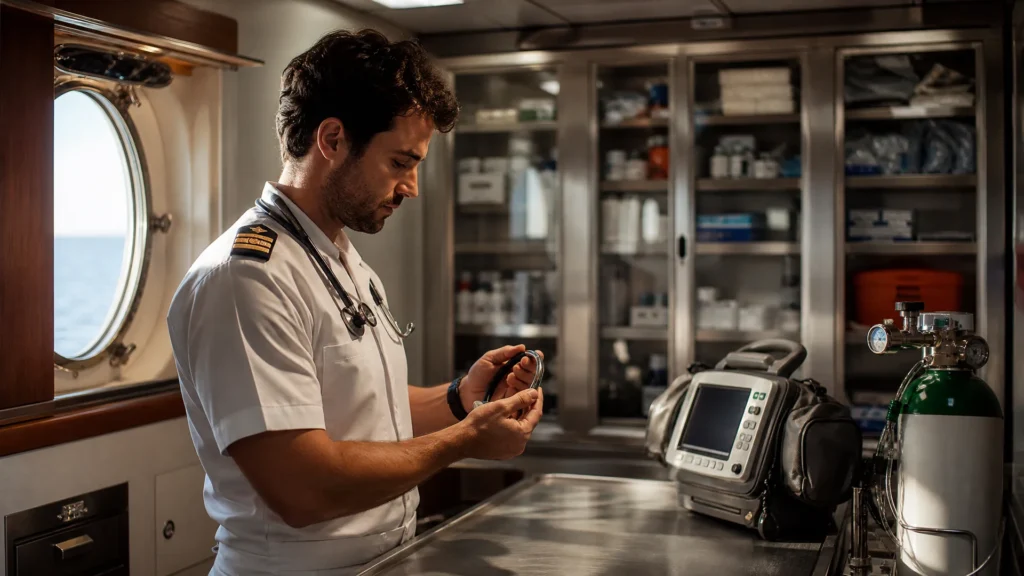
Superyacht medical officer certification
Superyacht medical officer certification is one of the most specialised qualifications in the industry, and one of the most in-demand. As yachts grow larger and venture further offshore, owners and operators need crew who can manage a genuine medical emergency days from the nearest hospital. If you’re considering this role, understanding exactly what’s required, legally, practically, and professionally, is the right place to start.
What Is a Superyacht Medical Officer?
A yacht medical officer is either a dedicated crew member or a dual-role professional responsible for all onboard medical care. On large yachts operating far from shore, this means managing everything from minor injuries to serious cardiac events, often without any outside medical support for hours or days.
The role is defined by both authority and accountability. The medical officer holds clinical decision-making responsibility on board, coordinates with shore-based doctors via telemedicine, maintains the ship’s medical log, and manages a medical inventory that can rival a small clinic.
How the Role Differs from Standard Crew First Aid
Every working seafarer holds some level of first aid training as part of their STCW certification. That baseline ensures any crew member can stabilise a casualty in the minutes before a trained responder takes over. First aid certification requirements for yacht crew cover the essentials: CPR, bleeding control, and basic casualty management.
The yacht medical officer role goes considerably further. Where standard first aid is about holding the line, the medical officer is the trained responder. They administer medications, interpret diagnostic readings, perform wound closure, and make clinical judgements that other crew are not qualified to make.
Where Medical Officers Fit in the Superyacht Hierarchy
The medical officer typically reports directly to the Captain and sits within the officer structure, often alongside the Chief Officer, or as a dedicated department head on the largest vessels. On smaller yachts, the role is frequently combined with a deck or interior position, but the medical authority remains separate and clearly defined in the vessel’s SMS (Safety Management System).
Understanding superyacht career ranks and progression timelines helps clarify where this specialism sits relative to other officer pathways and what long-term progression looks like.
Core Superyacht Medical Officer Certification Requirements
The legal foundation for superyacht medical officer certification is the STCW certification on superyachts framework, specifically the two medical modules under Regulation VI/4 of the STCW Convention.
STCW Medical First Aid and Medical Care Modules
STCW Convention Regulation VI/4 defines two distinct competency levels. Table A-VI/4-1 covers Medical First Aid, the standard requirement for all seafarers designated to provide first aid on board. Table A-VI/4-2 covers Medical Care, the higher-level qualification for the officer in charge of medical care on the vessel.
The Medical Care certificate (A-VI/4-2) is the gateway qualification for any formal medical crew superyacht role. Without it, a candidate cannot legally serve as the designated medical officer on a commercially operated vessel. This module covers patient assessment, pharmacology, minor surgical procedures, and medical record-keeping to a professional standard.
Flag State and MCA Offshore Medical Officer Standards
Beyond the STCW baseline, flag state requirements add another layer. The MCA (Maritime and Coastguard Agency) and equivalent authorities in popular flag states, including Cayman Islands, Malta, and Marshall Islands, may specify additional standards for vessels above certain gross tonnage thresholds or for yachts carrying passengers commercially.
Under MLC 2006, vessels with 100 or more seafarers on international voyages lasting more than three days must carry a qualified medical doctor. Yachts below that threshold must carry a designated officer holding the Medical Care certificate, making that qualification directly tied to the vessel’s legal compliance. The medical officer’s role is not optional on vessels that meet the relevant criteria; it is a flag-state and class-society mandate.
Specialized Marine Medical Training for Superyachts
Mandatory minimums get you through the door. What makes a candidate stand out, and what large expedition yachts genuinely require, is training that goes well beyond the STCW modules.
Advanced Offshore and Remote Medical Courses
Offshore and remote medicine diplomas, delivered through recognised maritime medical training providers, prepare crew for prolonged patient care when evacuation is not immediately possible. These courses cover wilderness and expedition medicine principles adapted for the marine environment: hypothermia management, dive accident response, obstetric emergencies, and multi-casualty management.
Advanced trauma life support (ATLS) and advanced cardiac life support (ACLS or equivalent) are increasingly listed as preferred or required qualifications in superyacht crew recruitment. Large expedition superyachts, particularly those undertaking polar or remote ocean passages, routinely specify a dedicated medical officer as a non-negotiable crew requirement, often alongside a fully equipped medical bay with defibrillators, ventilators, and surgical kits.
Telemedicine, Pharmacology, and Equipment Proficiency
Modern superyachts run sophisticated telemedicine systems that connect the onboard medical officer with shore-based physicians in real time. Using them effectively, transmitting ECG readings, sharing wound images, documenting treatment, is a practical skill employers test for directly.
Pharmacology competence is equally important. A yacht medical officer manages a controlled drug inventory and must administer, document, and account for prescription medications under the supervision framework set by the vessel’s flag state. Equipment proficiency, from ultrasound to ventilator operation, is trained hands-on, which is why practical marine medical training superyacht courses carry real weight with recruitment agents.
Safety Compliance and Regulations Governing Medical Crew
Three regulatory frameworks shape the medical officer’s day-to-day responsibilities: the ISM Code, MLC 2006, and flag-state health and safety requirements.
The ISM Code (International Safety Management) requires every vessel to have a documented SMS covering medical procedures, emergency response, and crew health. The medical officer owns a significant portion of that documentation, injury logs, medication records, drill reports, and is accountable to both the Captain and the Designated Person Ashore (DPA) during audits.
MLC 2006 (Maritime Labour Convention) sets minimum standards for crew health, medical treatment access, and sickness benefits. Regulation 4.1 and Standard A4.1 specifically address shipboard medical care, requiring vessels to carry appropriate medicines, equipment, and qualified personnel proportionate to their crew size and voyage profile.
Safety compliance training for superyacht crew is built around these frameworks. A medical officer who produces clean, well-maintained records is demonstrably more employable than one who treats paperwork as an afterthought, and flag state surveyors, charter guests, and owners all notice the difference.
Career Outlook: Salary, Demand, and Progression as a Yacht Medical Officer
Demand for certified offshore medical officers on superyachts has grown steadily as the fleet of large expedition and charter yachts expands. In 2026, vessels above 60 metres, especially those operating in high-latitude or remote destinations, routinely specify a dedicated medic. The pool of candidates with the right combination of STCW Medical Care, advanced offshore training, and superyacht experience remains relatively small.
That supply-demand gap translates into strong compensation. Dedicated yacht medical officers on large private or charter vessels earn well relative to equivalent shore-based roles, and the position typically includes full board, generous rotational schedules, and travel to exceptional destinations.
Dual-role medical officers are increasingly sought on private yachts where owners want to minimise headcount without compromising on safety. Crew who combine a recognised medical qualification with a watchkeeping certificate or interior management experience are exceptionally marketable. Deck officer certification pathways are one natural complement for candidates thinking about this combination.
Progression from the medical officer role can move toward fleet medical manager positions, maritime health consultancy, or senior officer roles on expedition vessels where the medic also carries watchkeeping responsibilities.
How to Get Your Medic Yacht Certification with SYTA
SYTA structures its training so every course builds logically on the last. Candidates don’t start with advanced modules before the foundations are solid.
The recommended sequence for anyone pursuing superyacht medical officer certification:
- Complete core STCW safety training, STCW Basic Safety Training (BST) is the non-negotiable starting point for all seafarers, covering firefighting, survival craft, personal survival, and first aid at the A-VI/4-1 level.
- Progress to STCW Medical Care (A-VI/4-2), the officer-level module that qualifies you as the designated medical officer on board.
- Add specialist offshore medical training, remote medicine diplomas, advanced life support, telemedicine, and pharmacology modules matched to the demands of large expedition and charter yacht operators.
The full range of superyacht crew training courses is available if you’re mapping out your wider certification plan. If the medical officer pathway is your focus, the best next step is straightforward: speak to a SYTA course advisor who can confirm which modules you need based on your current certificates and target vessel type.
Ready to take the next step? Contact a SYTA course advisor today to build your personalised certification plan, or browse our medical and safety training courses and find the right starting point for where you are now.