
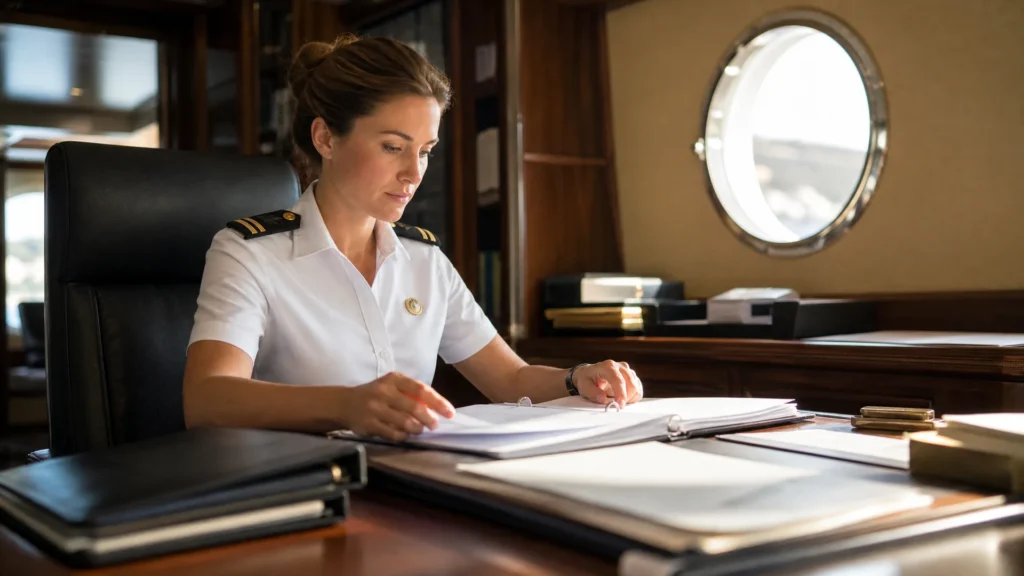
Superyacht Purser Training Course Guide
The purser is one of the most underrepresented roles in superyacht career content, yet on large charter vessels it is one of the most operationally critical. If you are drawn to administration, compliance, and financial management rather than service delivery, a superyacht purser training course opens a distinct management pathway that sits entirely outside the deck officer and interior hospitality tracks. This guide explains what the role involves, which vessels employ one, what a structured course covers, and how to take the next step with SYTA in 2026.
What Does a Superyacht Purser Actually Do?
A superyacht purser is the administrative and financial backbone of the vessel. Deck officers manage navigation and safety. The interior team manages guest experience. The purser manages the business of running the yacht: payroll, compliance paperwork, budgets, and port administration.
The role is sometimes described as a yacht administrative officer, and that framing is accurate. The purser owns documentation, crew records, and financial reconciliation. None of those tasks disappear when charter season is in full swing; they intensify.
Purser vs. Chief Stewardess: Understanding the Difference
The chief stewardess leads the interior crew and is accountable for guest service standards, cabin presentation, F&B coordination, and the day-to-day management of steward/ess teams. That is a demanding hospitality management role. The purser’s responsibilities sit alongside this hierarchy rather than inside it.
A purser does not report to the chief stewardess. They typically report directly to the captain, because their work, flag state documentation, crew payroll, charter accounting, customs declarations, is operational and compliance-driven rather than service-driven.
Candidates exploring chief stewardess training and leadership certifications will find a very different curriculum from purser training, which reflects just how distinct these two management functions are aboard the same vessel.
Core Superyacht Purser Responsibilities
The purser’s daily and weekly workload typically includes:
- Crew payroll and contracts, managing wages across multiple nationalities and currencies, tracking leave, and maintaining employment records.
- Provisioning budgets, raising purchase orders, reconciling supplier invoices, and reporting expenditure against charter income.
- Guest accounting, producing end-of-charter financial summaries, handling advance provisioning accounts (APAs), and processing crew gratuities.
- Port clearance and customs, preparing and submitting the documentation required for every arrival and departure, in every jurisdiction.
- Flag state and ISM documentation, tracking certificate expiry dates, coordinating renewals, and maintaining the Safety Management System records.
- HR administration, onboarding new crew, maintaining qualification records, and ensuring flag-state compliance with minimum manning requirements.
On charter yachts above 60 metres, a dedicated purser routinely manages crew payroll across multiple nationalities, coordinates flag state documentation renewals, and reconciles guest provisioning accounts. These tasks are too complex and too frequent to sit inside the interior hierarchy alongside service duties.
Which Yachts Employ a Dedicated Purser?
Pursers are most commonly found on yachts above 50–60 metres. Below that threshold, the captain and chief stewardess typically absorb administrative tasks between them. Above it, crew numbers grow, charter schedules intensify, and the paperwork burden reaches a point where a specialist officer is a practical necessity, not a luxury.
The role is most visible on expedition-style and luxury charter vessels operating continuous global itineraries, where port clearances, customs declarations, and multi-currency crew wages must be handled with near-daily precision. A vessel moving through three different flag jurisdictions in a single month generates administrative complexity that no captain can reasonably absorb alongside navigational duties.
Privately owned yachts in this size bracket also employ pursers, particularly where owners demand rigorous financial reporting or the vessel operates under a commercial flag for tax purposes. As flag state compliance requirements have tightened through the mid-2020s, the purser has become a standard appointment rather than an exceptional one on yachts of this size.
Purser Superyacht Training: What the Course Covers
A purpose-built superyacht purser training course covers the practical skills a purser needs from day one aboard, not generic maritime administration theory. The curriculum maps directly to the tasks listed above, structured across two main competency pillars.
Financial Management and Budgeting Skills
This strand covers everything from reading and preparing a provisioning budget to reconciling an APA at the end of a two-week charter. Students learn how to track expenditure in real time, produce accurate financial reports for owners and management companies, and manage multi-currency transactions without errors that create downstream accounting problems.
Crew payroll sits in this section too: calculating wages correctly across different contract types, handling tax withholding obligations for crew from various countries, and documenting gratuity distributions. These are skills that interior crew leaders rarely develop through service alone, and they are among the areas where candidates transitioning from a chief stewardess background most consistently identify structured training as delivering the greatest return.
Flag State Compliance, Documentation and Maritime Admin
Flag state compliance is where a purser’s work becomes genuinely high-stakes. An expired certificate, a missed customs declaration, or incorrect crew documentation can delay a vessel, generate fines, or create liability for the owner.
This curriculum strand covers ISM documentation, Safety Management System record-keeping, port state control preparation, and the documentation flows required under the most common commercial yacht flags. Students also work through crew visa requirements, minimum safe manning certificates, and the basics of maritime HR compliance.
Understanding STCW certification requirements for superyacht crew forms part of the compliance context here, the purser is often responsible for tracking and verifying that every crew member’s certificates are current before a vessel departs port.
Certifications and Prerequisites for Purser Training
Purser training is not an entry-level path. Candidates typically arrive with some foundation already in place.
STCW Basic Safety Training is the standard prerequisite for any professional superyacht crew role and is required before enrolling in a purser programme. This covers the personal survival, fire prevention, first aid, and sea survival competencies mandated under the STCW Convention, administered by the International Maritime Organization.
Beyond STCW, most programmes expect candidates to have at least one to two seasons of interior or administrative experience aboard a yacht, or equivalent professional experience in hospitality finance, hotel management, or corporate administration ashore. This background ensures students can apply the curriculum to real operational scenarios rather than working through it in the abstract.
A yacht purser certification from a recognised maritime training body strengthens a candidate’s profile significantly when approaching crewing agencies or vessel management companies. The purser is increasingly recognised as a distinct management officer rather than a senior interior crew member. That shift is driven by the growing complexity of flag state compliance, charter tax regulations, and multi-nationality crew administration on vessels over 50 metres. Holding a formal certification signals professional standing in that context.
Superyacht Management Roles: Career Progression from Purser
The purser pathway is one of three distinct management tracks on a large yacht, alongside deck officer progression and the interior leadership route. Understanding this shapes how you think about the career long-term.
A junior purser or purser’s assistant typically joins a vessel above 50 metres, handling administrative tasks under the supervision of a more senior purser or the captain. From there, progression moves toward lead purser on a large charter yacht, with full ownership of all the financial and compliance functions described above.
Beyond the vessel, experienced pursers move into shore-side superyacht management. Fleet administrators, yacht management company compliance officers, and charter operations managers are all roles where a purser’s skillset, financial discipline, documentation rigour, cross-cultural crew management, translates directly. Some pursers move into flag state consultancy or maritime HR, applying their compliance knowledge in a broader commercial context.
Compare this trajectory with the chief stewardess track, which leads toward interior management roles, training delivery, and guest experience consultancy. Or the deck officer track, which leads toward master’s certification and command. The purser route is the management pathway for people whose strengths are financial and administrative rather than navigational or service-oriented.
For those benchmarking salary potential, interior crew salary ranks and rates provide useful context across the interior management hierarchy. The purser, as a dedicated management officer, typically commands a salary that reflects the complexity and compliance responsibility of the role.
If you want to understand salaries, travel, and career progression in superyachts more broadly before committing to the purser track, that context is worth reviewing. Once qualified, how to find superyacht crew jobs after qualifying is the practical next question, and the purser designation makes candidates immediately identifiable to vessels that need this specific skill set.
How to Enrol in a Superyacht Purser Training Course at SYTA
SYTA’s training programmes are built specifically for the superyacht sector and delivered from Cape Town, an active yachting hub that gives students direct exposure to the industry context they are training for. The purser course is designed for 2026 intake with flexible scheduling to accommodate candidates who are between seasons or transitioning from a shore-based career.
To prepare for enrolment, you should have:
- A valid STCW Basic Safety Training certificate.
- Evidence of interior, hospitality, or administrative experience (yacht-based or equivalent).
- A clear understanding of which size of vessel you are targeting, this shapes how the course content applies to your goals.
From there, the process is straightforward. Browse SYTA’s full range of superyacht crew training courses to confirm the purser programme fits your current stage, then use the Find a Course function on the SYTA website to check 2026 intake dates and submit your enquiry.
The administrative pathway on large yachts is growing in demand and short on formally trained candidates. A superyacht purser training course with SYTA gives you the certification, the skills, and the professional standing to step into that gap, on the vessels that need it most.