
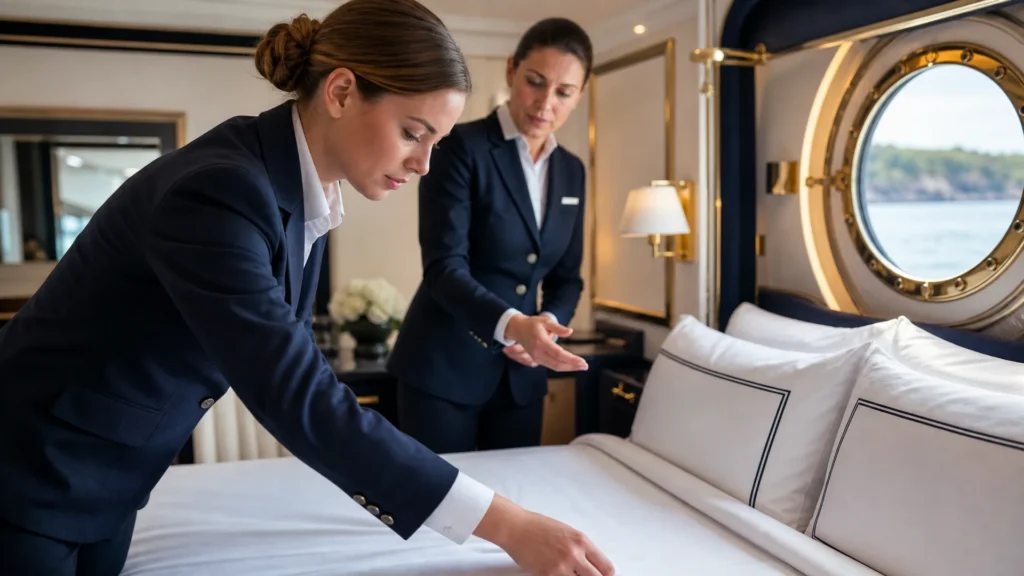
Superyacht owners hire interior crew for polish, not just paperwork. If you’re aiming for a paid role on a superyacht, you need more than a single certificate. You need the right sequence of superyacht interior training courses, taken in an order that actually gets you hired. This guide breaks down which courses map to which rank, what training in Cape Town looks like in practice, and how to move from zero experience to a paid interior position without wasting weeks on the wrong certificate first.
The Superyacht Interior Department: Roles You’re Training For
Before picking courses, you need to know what job you’re training for. The interior department runs on a clear rank structure. Each rank carries different expectations for skill, certification, and leadership.
Training that suits a junior steward won’t prepare you for a chief stew role. So it helps to map the hierarchy first. Then work backward to the certifications each rank actually requires.
Steward/Stewardess vs. Senior Stew vs. Chief Stew
A junior steward or stewardess handles cabin service, laundry, and general guest care under supervision. A senior stew takes on more responsibility: service standards, provisioning input, and mentoring junior crew.
A chief stew runs the entire interior department. They manage budgets, staff, guest preferences, and standards across the whole boat.
Each step up the ladder demands broader hospitality skills and stronger leadership training, on top of the safety certifications everyone needs. For a closer look at what each rank actually does day to day, the full breakdown of interior crew roles and responsibilities is worth reading before you commit to a course pathway.
What Recruiters Expect at Each Rank
Recruiters filter entry-level applicants mainly on STCW compliance and basic hospitality polish. For senior and chief stew roles, they look for proven service experience, wine and silver service training, and evidence of leadership.
Recruiters consistently favor interior crew who pair mandatory STCW compliance with demonstrable hospitality training. Owners and captains treat guest-service polish as a hiring filter, not a nice-to-have.
STCW for Superyacht Interior Crew: The Non-Negotiable Basics
STCW Basic Safety Training is mandatory for every crew member on a superyacht, regardless of department. This applies to interior, deck, and engineering crew alike. Without it, you can’t legally work on most commercial or large private yachts.
The good news for aspiring stews: you don’t need the full deck-officer STCW stack. Interior crew only need the basic safety modules, not the navigation or engineering-focused certificates that deck and engine departments pursue.
Which STCW Modules Interior Crew Actually Need
Interior crew need the STCW Basic Safety Training package. This covers personal survival techniques, fire prevention and firefighting, elementary first aid, and personal safety with social responsibility.
Some interior crew also add security-related modules, depending on the flag state and vessel type. Beyond that, you don’t need to chase advanced fire-fighting tickets or navigation-focused certificates. Those belong to deck and engineering pathways, not interior. If you want the exact STCW Basic Safety Training requirements broken down module by module, check that before you book a course.
Doing STCW in Cape Town
Cape Town runs STCW Basic Safety Training regularly, with practical sessions covering pool-based survival drills and firefighting exercises. Training here tends to move at a steady, structured pace. That gives new crew a realistic feel for shipboard safety drills before they ever set foot on a yacht.
If you’re planning your first trip to South Africa for training, it helps to understand what STCW training in Cape Town actually involves before you arrive, including how the practical and classroom components are split.
Superyacht Interior Certification Requirements Beyond STCW
STCW gets you legally compliant. It doesn’t teach you how to fold napkins for a formal dinner service, pour wine correctly, or read a demanding guest’s mood before they say a word. That’s where interior-specific certification requirements come in, and it’s the part generic maritime academies routinely skip.
Owners aren’t hiring lifeguards. They’re hiring hospitality professionals who happen to work at sea. Skipping this layer of training is the single biggest reason qualified-on-paper candidates struggle to get hired.
Silver Service, Wine Service, and Hospitality Standards
Silver service training teaches the formal plating, serving, and table-clearing techniques used in high-end dining. On a superyacht, guests expect restaurant-grade service, often several times a day, in a much smaller space than any restaurant.
Wine service training covers proper pouring technique, glassware handling, and enough working knowledge to answer basic guest questions about what’s being served. Broader hospitality training rounds this out. It covers guest etiquette, cabin presentation, and the interpersonal judgment that separates a good stew from an average one.
Together, these skills form the practical core of superyacht hospitality training. Recruiters treat it as a baseline expectation for interior crew, not an optional extra.
How SYTA’s Foundations of High-End Hospitality Course Fits In
SYTA built its Foundations of High-End Hospitality course to close the gap between generic hospitality training and the silver-service, wine, and guest-etiquette standards superyacht owners expect from interior crew. Think of it as the interior department’s equivalent of STCW: a baseline course that gives you the vocabulary, technique, and confidence to walk onto a yacht ready to work.
For someone with no prior hospitality background, this course is usually the single highest-value certificate you can add after STCW. It directly targets the skills recruiters check for in interviews, rather than the general theory a land-based hospitality diploma might cover.
How to Become a Superyacht Stewardess: Sequencing Your Courses for Fastest Entry
Course order matters as much as course content. Take certifications in the wrong sequence and you’ll either delay your job search or pay for training that doesn’t match what recruiters are asking for at the time you apply.
The Fastest Route from Zero Experience to Paid Interior Job
Start with STCW Basic Safety Training. It’s a legal requirement, and no reputable yacht will consider you without it. Next, complete a hospitality and silver-service course such as Foundations of High-End Hospitality. This adds the guest-facing skills recruiters filter for.
From there, consider a fast-track stewardess certification course that combines interior-specific skills training with practical guidance on the job search itself.
A career-changer with no maritime background can realistically sequence STCW Basic Safety Training, a hospitality and silver-service course, and an interior-specific stew course within a matter of weeks. After that, they can start actively applying for entry-level positions with a complete, recruiter-ready certification set.
Common Sequencing Mistakes That Slow Down Placement
The most common mistake is booking hospitality training before STCW. Without STCW, most agencies won’t even submit your CV. Another mistake is skipping silver service and wine training entirely, assuming general customer-service experience will cover it. It won’t. Recruiters check for it specifically.
A third mistake is over-investing in advanced or chief-level courses before landing a first entry-level role. Advanced training pays off once you have sea time and rank progression to justify it. Applying too early to advanced courses, before entry-level placement, often just delays your start date.
Why Cape Town Is a Leading Hub for Superyacht Interior Crew Courses
Cape Town has built a strong reputation for superyacht crew course delivery, and interior training is no exception. The city sits close to major yachting hubs and hosts a training calendar built specifically around crew career timelines.
What Makes Cape Town Training Practical for Interior Roles
Cape Town has become a practical base for interior crew training because it combines lower training and living costs with a genuine yachting industry presence. That lets students train and network in the same city, rather than commuting between disconnected training centres and crew hubs.
South Africa’s yachting season and crew turnover also mean students can often connect with placement agencies and fellow crew locally, right after finishing their courses. For anyone specifically searching for yacht interior crew training in South Africa, this combination of affordability and industry access is a major part of the appeal. It’s also the reason SYTA runs its interior programs from a Cape Town base rather than a purely online model.
Interior Rank Salary Benchmarks and Next Steps After Certification
Certification is the entry ticket. Pay progression is the payoff. Understanding roughly what each rank earns helps you set realistic expectations, and gives you a clear incentive to keep building qualifications once you’re on board.
What You Can Expect to Earn as You Progress
Junior stewards and stewardesses typically start at entry-level pay. That reflects their limited experience and supervised responsibilities. Senior stews earn more, in line with their added responsibility for service standards and junior crew.
Chief stews run an entire department and manage budgets and guest relationships. They sit at the top of the interior pay scale. Progression through these ranks usually tracks directly with certification and proven sea time, which is why many interior crew pursue chief stewardess training and leadership certifications once they’ve built a season or two of experience. For a fuller picture of how pay scales by rank, a steward salary breakdown by rank is a useful reference while you plan your career timeline.
Readers aiming higher up the ladder from the start might also look at SYTA’s Advanced Stewardess Career Course, which builds on the foundations with more advanced service and leadership content.
From Certificate to Placement: Finding Your First Interior Job
Once you’ve completed STCW and your hospitality certification, the next step is turning that paperwork into an actual placement. Agencies and captains look for a clean, well-formatted CV that leads with your certifications and any hospitality experience.
If you’re not sure how to present your training on paper, tips for getting your CV noticed by recruiters can help you avoid the formatting and content mistakes that get otherwise-qualified applicants overlooked.
Cape Town’s combination of practical training and industry proximity means the gap between certificate and interview can be short, provided your course choices and your CV both reflect what recruiters are actually screening for. Start with STCW. Add hospitality and silver-service training through a course like Foundations of High-End Hospitality. Then you’ll be applying for entry-level interior roles with the right qualifications already in hand.