
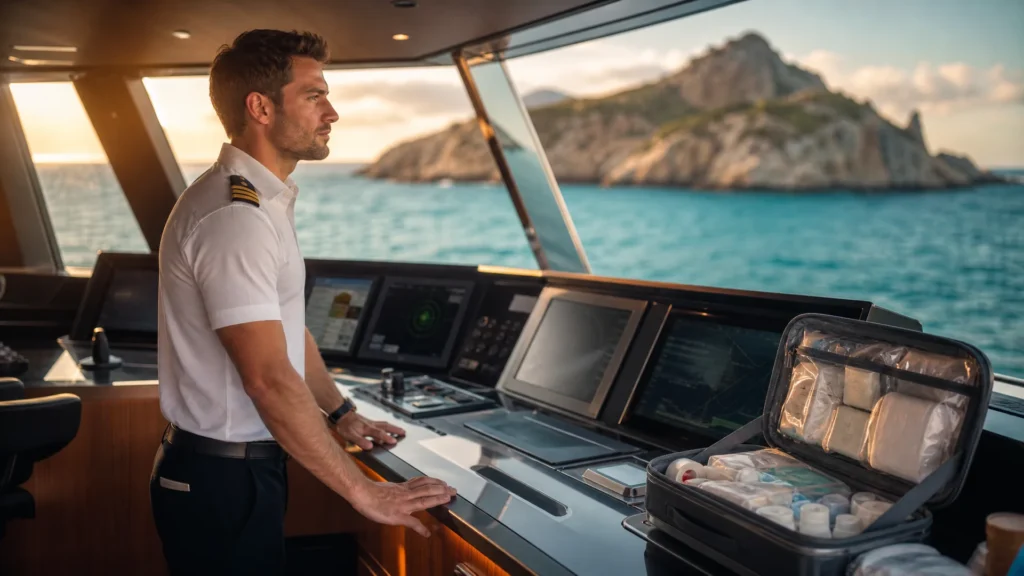
A superyacht at anchor off a remote island has no ambulance on call and no emergency room down the road. When a guest or crew member falls ill or gets hurt, the person who steps in first is usually a crew member with dedicated medical training, not a doctor. Understanding superyacht medical officer training requirements matters for anyone building a serious career on deck or interior. Medical responsibility tends to land on crew earlier than most newcomers expect.
This guide walks through what the role actually involves, the certifications behind it, and the realistic pathway from entry-level crew to medical officer.
What Is a Superyacht Medical Officer, and Why the Role Exists
A superyacht medical officer is the crew member responsible for medical care onboard. This isn’t usually a standalone job title. It’s a duty assigned to someone who already holds another rank, such as bosun, chief stew, or an officer of the watch.
The captain designates this person based on training, seniority, and often personal aptitude. Once designated, that crew member becomes the point of contact for everything from seasickness to serious trauma, until professional help can be reached.
Commercial ships carry cargo and a fairly small, trained crew. Superyachts carry paying guests, owners, and their families. These people didn’t sign up for the physical demands of life at sea, and they expect a level of care that matches the rest of the onboard experience. That difference in who’s onboard, combined with how far superyachts often operate from shore, is why the medical standards run higher than on a typical merchant vessel.
Medical Officer vs. General Medical Crew Member
Most crew complete some form of first aid training as part of basic STCW requirements. That covers general medical crew duties: treating minor injuries, assisting in emergencies, and knowing when to escalate.
A medical officer sits above that baseline. They’ve completed advanced medical training. They’re the person the captain calls first in a serious incident, and they typically manage the ship’s medical locker, medications, and documentation. The distinction matters because insurers and yacht managers look for a named, advanced-certified individual, not just a crew of first-aid-trained generalists.
STCW Medical First Aid Superyacht Requirements Explained
STCW medical first aid superyacht training sits within the STCW convention’s medical framework, which sets two distinct tiers. Getting these tiers right is the first step in understanding medical officer superyacht certification.
The first tier is Medical First Aid. It’s designed for crew designated to provide first aid onboard and covers patient assessment, basic trauma care, and stabilizing someone until further help arrives. Most superyachts need several crew holding this certificate, not just one.
The second tier is Advanced Medical First Aid, sometimes referred to as Medical Care. This is the requirement for whoever takes charge of medical care onboard: the medical officer. The course goes deeper into diagnosis, medication administration, minor procedures, and coordinating care during a prolonged emergency at sea.
For the specific units, hours, and prerequisites behind each level, the detailed medical officer certification requirements break down exactly what each course covers.
Who Needs Basic Medical First Aid vs. Advanced Medical First Aid
Any crew member designated to provide first aid onboard needs Medical First Aid. On most yachts, that’s several people across departments, because emergencies don’t wait for the “right” crew member to be on shift.
Advanced Medical First Aid is narrower. It’s required for the one person designated to take charge of medical care, usually just one or two crew per vessel. That person becomes the onboard medical officer.
Both certifications sit under the broader STCW framework, and the yacht crew first aid certification legal requirements explain how flag states and vessel size determine exactly who needs what.
Medical Officer Superyacht Certification Pathway and Timeline
There’s no shortcut to becoming a medical officer. It’s a role you grow into as you gain sea time, trust, and the right certifications in sequence.
Typical Progression From Crew to Medical Officer
The path usually starts with basic STCW training, the entry point for any yacht crew role. From there, most crew complete Medical First Aid early in their career, often within their first contract or two, since it’s a common baseline requirement across departments.
Crew who progress from deckhand or stewardess roles into medical officer responsibilities typically complete Medical First Aid before moving on to Advanced Medical First Aid as they gain seniority. That sequencing isn’t arbitrary. Advanced Medical First Aid courses build on the assessment skills taught at the basic level, so most training providers expect the first certificate before you can enroll in the second.
Sea time and experience matter here too. Captains generally prefer to designate someone who has already handled real onboard situations, whether that’s a guest with a minor injury or a crew member’s medical concern, before handing over full medical responsibility. This progression mirrors the broader typical superyacht career progression timeline, where rank and responsibility tend to build together rather than jumping straight to the top.
How Long Certification Takes
There’s no fixed number of years attached to becoming a medical officer. It depends on how quickly you accumulate sea time and how soon a captain is ready to designate you. Basic STCW training and Medical First Aid can both be completed in a matter of days, back to back, early in a crew career.
Advanced Medical First Aid usually comes later, once you’ve built up practical experience and a captain or yacht manager sees you as a candidate for the role. For many crew, that means completing the advanced course somewhere in their second or third year onboard, though it can happen sooner for those on smaller crews where medical duties get assigned earlier out of necessity.
Medical Responsibilities on High-Net-Worth Charters
Charter guests expect discretion as much as competence. A medical officer on a busy charter yacht deals with everything from a child’s scraped knee to a guest’s pre-existing condition that needs quiet, careful management throughout the trip.
On a 60m+ charter yacht with a rotating guest list of high-net-worth families, the designated medical officer is often the safety officer or senior stew who has completed advanced medical training rather than a dedicated onboard doctor. That person needs to handle chronic conditions, medication schedules, and allergies without disrupting the guest experience or breaching confidentiality.
When something more serious happens, the medical officer coordinates with telemedicine services. They relay vital signs and symptoms to physicians ashore, who guide onboard treatment until evacuation or a port call is possible. This is where superyacht medical emergency protocols really get tested. The officer has to stay calm, document accurately, and make judgment calls with real liability attached to every decision.
Liability, Insurance, and Why Standards Are Higher on Superyachts
Superyachts frequently operate days from the nearest hospital while carrying guests and crew who expect a standard of care closer to a private clinic than a commercial vessel. That gap between expectation and geography is exactly why insurers and management companies push crews toward the advanced tier of STCW medical certification.
Commercial vessels carry trained seafarers who understand the risks of life at sea. Superyachts carry guests who are often unfamiliar with those risks, sometimes elderly, sometimes with existing health conditions, and always expecting the yacht to manage any medical issue smoothly. That liability exposure is why yacht management companies typically won’t sign off on a charter without a named, advanced-certified medical officer onboard.
Captains and yacht managers generally require at least one advanced-certified medical officer onboard before signing off on charter itineraries in remote cruising grounds like the South Pacific or high Arctic. Insurance policies increasingly reflect this too. Underwriters now treat a properly certified medical officer as a condition of cover, not a nice-to-have. For a broader view of how medical certification fits alongside the rest of a crew member’s paperwork, the full list of superyacht crew certifications lays out every requirement by department and rank.
How to Become a Yacht Medical Officer: Getting Started
If you’re asking how to become a yacht medical officer, the sequence is straightforward even if the journey takes time. Start with basic STCW training if you haven’t completed it, then move into a superyacht medical training course covering Medical First Aid.
Build sea time, take on medical responsibilities where they’re offered, and let your captain or yacht manager see you as reliable under pressure. When you’re ready, and once you meet the prerequisites, enroll in Advanced Medical First Aid to qualify as a designated medical officer.
For the full regulatory picture behind these courses, the complete STCW certification guide is a useful starting point before you book anything. When you’re ready to start or advance your certification path, browse superyacht crew training courses and use Find a Course to match your current rank with the right medical training level for where you want to go next.