
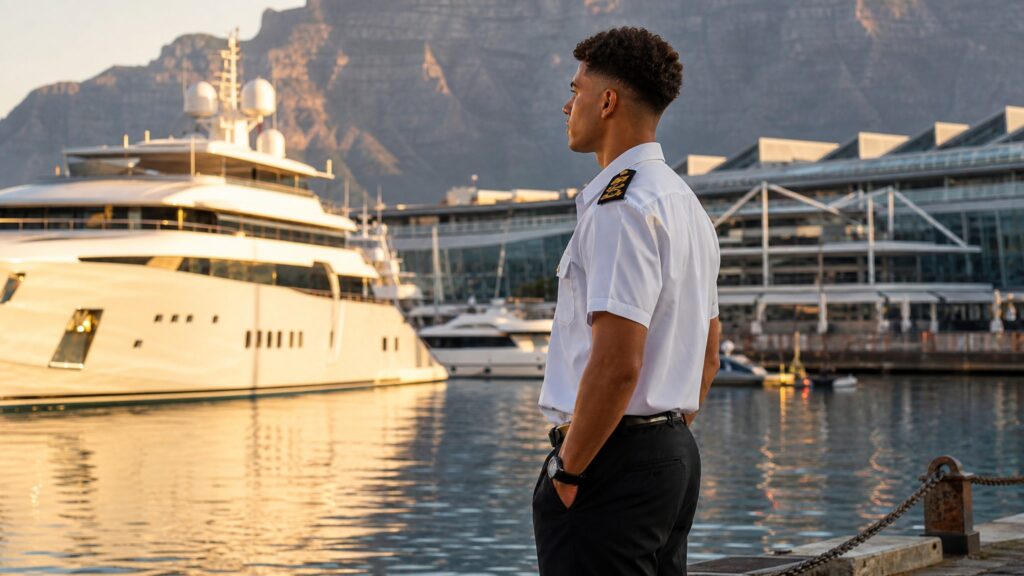
Search for a superyacht crew course near you in South Africa and you’ll get scattered results across coastal towns. But the industry’s true center of gravity sits in one specific location. You’ll find general maritime safety providers in Durban or Port Elizabeth, but Cape Town is the primary hub for dedicated superyacht training, thanks to its deep-water port infrastructure and the concentration of crew agencies working out of it. International standards meet local accessibility here, which makes it the clear answer for anyone serious about entering the sector from South African soil.
Cape Town’s V&A Waterfront precinct hosts multiple accredited maritime training facilities and crew agencies. That makes it the functional center for South African superyacht recruitment. If you’re based elsewhere in the country, relocating to Cape Town for your certification period isn’t just a logistical suggestion. It’s a strategic move that puts you directly in the hiring pipeline.
Why Cape Town Is the Hub for Yacht Crew Training in South Africa
Yacht crew training in South Africa varies a lot in quality and industry relevance. Cape Town stands apart because it integrates classroom learning with active port operations. The city’s maritime ecosystem supports a density of specialized instructors and recruitment offices that simply doesn’t exist in other provinces, so your training lines up with what employers actually expect right now.
That geographic concentration matters when you search for a superyacht academy in South Africa. You’re effectively looking for institutions embedded within this working harbor environment, not isolated classrooms. SYTA maintains its presence here specifically to use that infrastructure, so every course connects directly to the operational realities of the vessels docked just kilometers away.
Employers prioritize candidates from niche superyacht academies over general maritime schools, because specialized training better reflects onboard service standards. Generalist maritime colleges may be cheaper or closer to home. But they can’t replicate the culture and technical precision a luxury vessel demands, which is why Cape Town remains the destination for credible certification.
Essential STCW Certification Courses for Aspiring Crew
STCW Basic Safety Training typically comprises four distinct modules, and every crew member must complete them before working aboard a commercial vessel. These certifications form the baseline for employment. No captain or management company will consider your application without verified proof of completion, regardless of your experience or enthusiasm.
Understanding Basic Safety Training Requirements
The mandatory STCW package includes Personal Survival Techniques, Fire Prevention and Fire Fighting, Elementary First Aid, and Personal Safety and Social Responsibilities. An approved provider has to deliver all four for them to hold international validity. You can’t substitute these with land-based first aid or firefighting courses: the maritime context brings variables like vessel stability and enclosed space hazards that generic training doesn’t cover.
SYTA offers bundled career packages that combine mandatory safety certifications with role-specific skills, so the path to employment stays streamlined. Most aspiring crew book their entire foundational qualification block in one continuous intake rather than booking modules separately and risking scheduling gaps.
Advanced Firefighting and Medical First Aid
You’ll need advanced certifications once you move beyond entry-level positions, or if you specialize in departments requiring higher safety oversight, such as deck officers or senior interior staff managing emergency response teams. These modules build directly on your basic training and require documented sea time or prerequisite completion, so plan your progression early and you’ll avoid bottlenecks later.
For detailed module breakdowns and current availability, superyacht STCW courses in Cape Town lays out the curriculum structure you need to verify compliance with MCA standards. Your safety qualifications expire after five years and need refresher training. Treat your initial certification as the start of an ongoing maintenance cycle, not a one-time checkbox.
Specialized Superyacht Career Pathways: Deck, Interior, and Engineering
Basic safety training qualifies you to step aboard. Specialized career courses are what distinguish you from hundreds of other applicants holding identical STCW certificates. Role-specific training shows employers you understand the actual daily demands of the position, bridging the gap between regulatory compliance and operational competence.
Deckhand and Bosun Training Tracks
Deck department training goes well beyond knot tying. It covers yacht maintenance, watchkeeping, tender operations, and line handling under real-world conditions. Entry-level deckhand courses focus on fundamental seamanship and safe working practices. Bosun tracks demand leadership development and advanced technical knowledge, preparing you to manage junior crew and run complex deck operations on your own.
Stewardess and Interior Service Excellence
Interior service training covers the hospitality standards luxury vessels expect: silver service, wine knowledge, housekeeping protocols, and guest interaction etiquette that differs fundamentally from hotel or restaurant work ashore. You learn to anticipate guest needs within the constraints of a marine environment, where resources are limited and privacy matters above almost everything else. Generic hospitality certifications don’t teach any of that.
Engineering and Technical Skill Development
Engineering pathways require rigorous technical preparation aligned with Maritime and Coastguard Agency competency standards, covering marine diesel engines, electrical systems, hydraulics, and auxiliary machinery specific to superyachts. This training differs from automotive or industrial mechanical courses because marine engineering demands familiarity with saltwater corrosion, vibration analysis, and redundant system operation, things land-based mechanics rarely encounter.
Specialized career courses teach the applied skills and departmental knowledge that determine your hireability and starting salary, on top of what basic safety training covers. Without that extra layer of qualification, you’re eligible only for the most junior positions, no matter how many safety certificates you hold.
Choosing an Accredited Yacht Crew School in Cape Town
Not every institution advertising a yacht crew school in South Africa holds the accreditation needed for flag states and insurance providers to recognize your certificates internationally. Pick an unapproved provider and you waste both money and time, because employers will reject non-compliant documentation during pre-employment vetting and you’ll be retraining at full cost.
Verifying MCA and SAMSA Recognition
Your chosen academy needs approval from both the South African Maritime Safety Authority and the UK Maritime and Coastguard Agency for your qualifications to transfer seamlessly to international vessels. SAMSA approval validates the training within South African jurisdiction. MCA recognition confirms your certificates meet the global standard that Mediterranean and Caribbean employers expect, since they dominate the superyacht market.
Our guide on how to choose a yacht crew training school walks through how to check accreditation claims against official registries. Never accept verbal assurances or outdated marketing materials as proof of current approval. Cross-reference with the issuing authority’s published list of recognized providers.
Evaluating Facilities and Instructor Experience
Training quality depends heavily on whether instructors have recent superyacht service experience, and whether practical exercises use equipment matching current industry specifications. Classroom theory alone can’t prepare you for the physical and psychological demands of life aboard. Check that your provider maintains functional fire grounds, survival pools, and workshop spaces that simulate actual vessel conditions, not just video demonstrations.
If you’re weighing options and searching for the best superyacht training course in Cape Town, prioritize institutions that publish instructor CVs and facility photos rather than relying on stock imagery or vague promises. Your training investment should open doors immediately, not create extra verification hurdles during job applications.
Course Scheduling and Seasonal Timing for 2026 Intakes
Timing your training to align with peak hiring cycles has a real effect on how quickly you land your first position after certification. Mediterranean season recruitment intensifies between January and March, while Caribbean hiring peaks from September through November. Aim to finish all coursework at least four weeks before those windows open, so there’s time for document processing and interviews.
Understanding the best time to do STCW course relative to global hiring patterns helps you avoid qualifying during off-season lulls, when competition is highest and vacancies are scarce. Late 2026 intakes position you well for the 2027 Mediterranean rush. Early 2027 enrollments target Caribbean summer placements, if you plan for it.
Course schedules fill months in advance during peak preparation periods, so waiting until you feel ready often means missing your optimal hiring window entirely. Secure your place now rather than assuming availability will hold, especially if you need visa processing or accommodation in Cape Town before training starts.
Financing Your Yacht Crew Training Investment
Professional superyacht training is a significant upfront cost. Financing options exist to make the career transition accessible without depleting the savings you’ll need for relocation or living expenses during your job search. Payment plans spread tuition across installments aligned with typical crew cash flow, which lowers the barrier to entry if you don’t have a lump sum ready.
Financing and payment options for crew training in Cape Town vary by provider, so ask directly about installment structures, deposit requirements, and any partnerships with lenders that specialize in vocational education. Treat this as a calculated investment rather than discretionary spending: industry salaries typically recoup training costs within three to six months of employment.
Budget for ancillary expenses too, including ENG1 medical examinations, passport renewals, seaman’s books, and temporary accommodation during training. These costs frequently catch new crew off guard and delay enrollment, so factor them into your financial planning alongside tuition.
Next Steps to Enroll in a Superyacht Academy
Securing your spot takes immediate action, because accredited intakes run on fixed dates with limited capacity set by safety ratios and instructor availability. Start by gathering your identification documents, medical fitness certificates, and any prior maritime qualifications you hold. These form the foundation of your enrollment application and verification process.
Submit your inquiry through our course pages today for current schedule availability and guidance on the right pathway for your career goals. Delaying risks losing preferred dates to applicants who moved faster, particularly for bundled packages that combine multiple certifications into efficient training blocks built for career changers and advancing crew alike.